
ArticleUpdated: September 6, 2026
Proportions in the drawing
In short
Proportions are checked with a pencil at arm's length, and there are two methods — both shown step by step. Then the canon of the human figure in heads, the layout of the face, how a child's proportions differ and the tricks that catch an error before the drawing is finished.

2D artist
Once upon a time, in the 18th century in France, an artist took a pencil, paper, tablet, easel and began to draw a picture, having never held a pencil in his hand before. The model's hands turned out to be long to the heels, the closet was the size of a pea, one leg was shorter than the other, and the mug of coffee became as tall as a house. He exhibited his work at a world-famous auction. And... no one ever saw him again. Since he did not know about proportions, how to find them and how to depict them, he went to study them. And of course, the name of this artist is unknown, because it's a joke! But nevertheless, it is important for artists to know what proportions are and how to apply them.
Figure proportions are easier to remember on the skeleton — we go through them step by step in the master class How to draw a human skeleton.
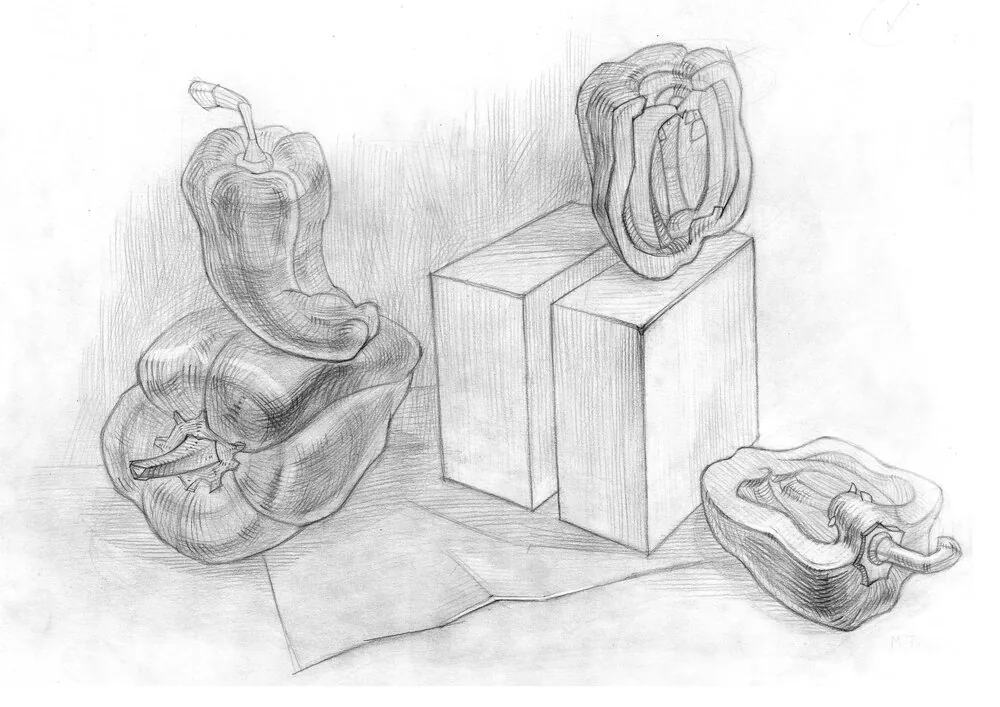 Thanks to them, the drawing looks convincing and consistent. And if you do not measure objects and do not compare their parameters, you can create a caricature picture where peppers will be the size of a plaster cube, which will violate their real sizes. The easiest way to practice looking for proportions is on ordinary objects: dishes or furniture. They have straight geometric silhouettes. But what to measure them with?
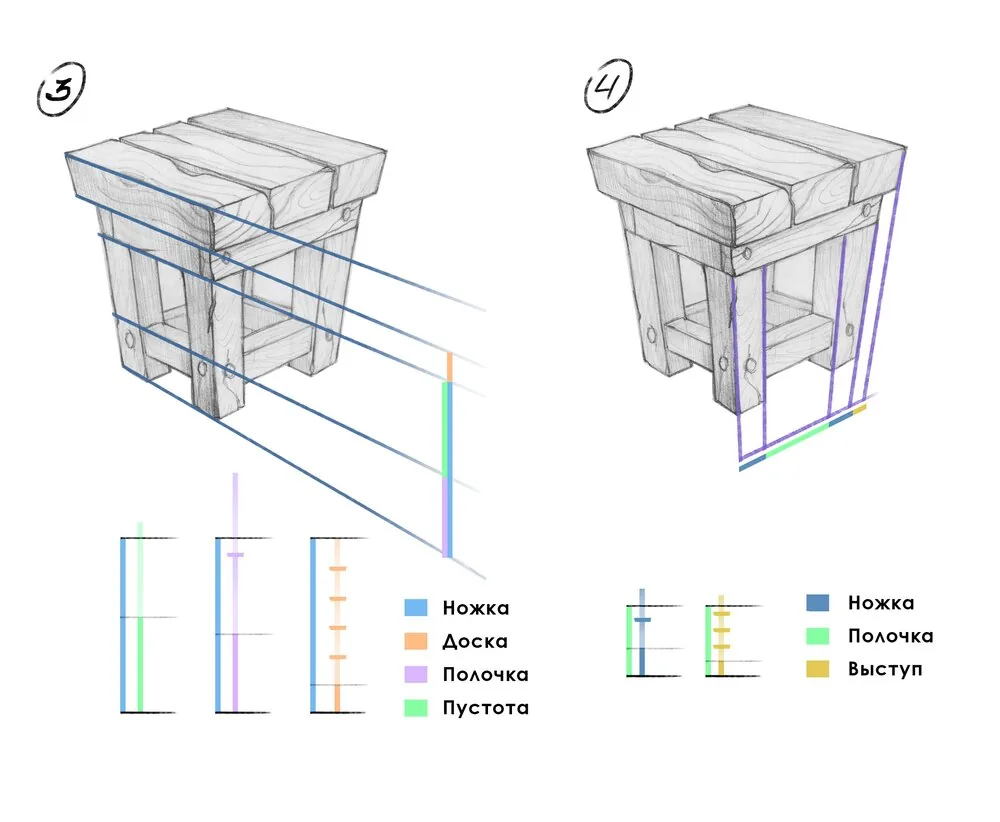
 We continue to look for proportions in the lower part of the stool. Since we saw that it consists of several elements, we note the heights of the board, voids, shelves and legs. Comparing smaller heights with the largest one, we get the following proportions:
Proportions in drawing
Proportions are the ratio of the sizes of elements of an object to each other or the ratio of elements to the whole. They reflect the uniqueness and features of objects, people, animals, architecture. The simplest proportion is the ratio of width to height. Or you can measure the height of one object in relation to another. For example: on the still life of student Mikhail Trusov, we note the height of the pepper, the height of the cube and the width of the face. The ratio of the height of the vegetable and the cube, the width of the protrusion of the cube to its height will be the proportion.
Thanks to them, the drawing looks convincing and consistent. And if you do not measure objects and do not compare their parameters, you can create a caricature picture where peppers will be the size of a plaster cube, which will violate their real sizes. The easiest way to practice looking for proportions is on ordinary objects: dishes or furniture. They have straight geometric silhouettes. But what to measure them with?
How to measure proportions in a drawing with a pencil
Method 1
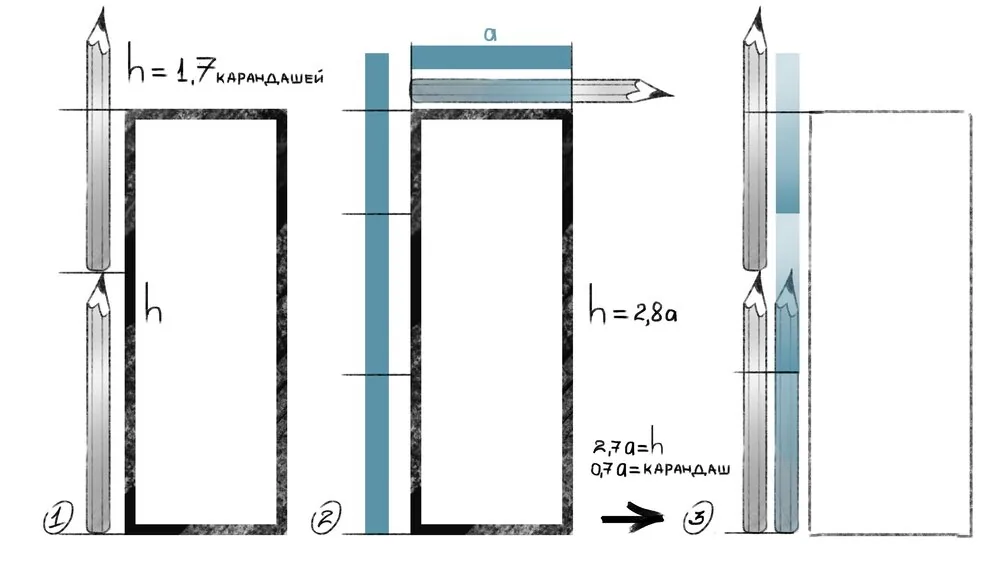
In ordinary life, we can take a ruler and measure the leg of the table in centimeters or inches. So in the drawing we need our own ruler. And this ruler becomes a pencil. In fact, you can take a sushi stick, a brush, a hairpin, any cane, the main thing is that it is smooth, without bends and branches. Let's take a rectangle, measure its height.- Step 1 - we apply the pencil to the object and see how many times the length of the pencil fits into the height of the rectangle. It turned out to be about 1.7 pencils.
- Step 2 - we apply the pencil to the width of the rectangle. The width is shorter than the pencil, we clamp the pencil with our finger where the rectangle ended. Let's call this length “a” and mark it in turquoise for наглядности. And then we measure the same length along the height. The width is shorter than the height and fits 2.8 times into the height of the rectangle.
- Step 3 - and now we transfer these measurements to our sheet and get a rectangle with the same proportions as the original. We also found the ratio of width to height. The width is shorter than the height and fits into it about 2.7 times.
Method 2
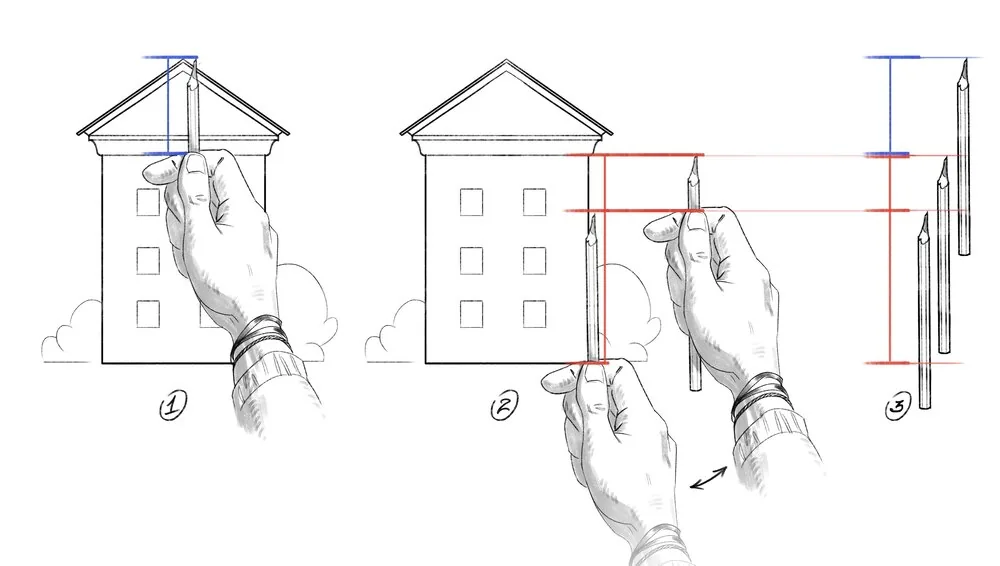
Such a measurement of proportions is suitable for small objects that are physically possible to measure with the length of a pencil. And if the object is large, for example a house, then we use a different method.- Step 1 - we take the same pencil and clamp it in our fist so that the thumb covers the trunk of the pencil. We stretch out our hand and under no circumstances bend it at the elbow. So all measurements will take place in the same conditions and we do the same manipulations as with the rectangle.
- Step 2 - and we transfer the proportions to the sheet. Some heights will not be measured with the entire length of the pencil, so moving the hand, we remember where the pencil lead ended on the object (we have this is the level of the third window) and from this mark we measure the remainder from the wall.
- Step 3 - adding up all three measured segments, we get the height of the house, as well as the height of the triangular pediment and the wall to it.
Proportions of objects in the drawing
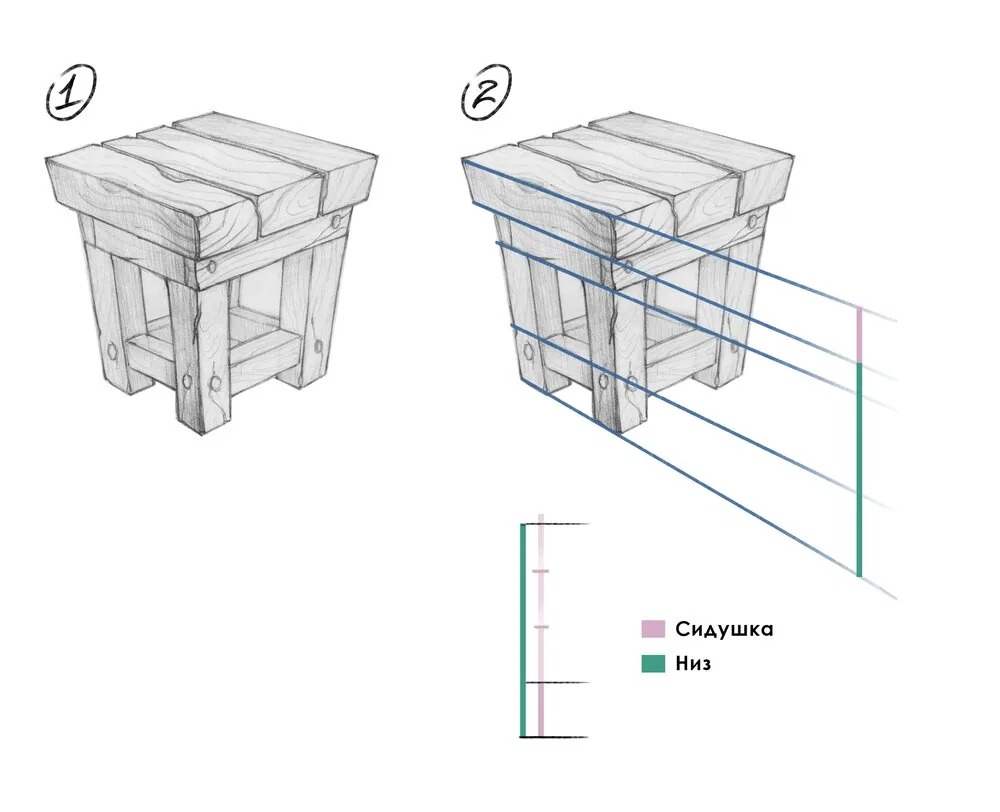
Let's take a piece of furniture - a stool for analysis and disassemble how to find proportions in objects on its example. Author of the sketch: student Darya Kostomarova. The stool is quite concise for research, but also filled with details.- First of all, we consider the object and note the important components: legs, seat, boards-shelves at the base. We also analyze whether the object is symmetric or not. In our case, the stool is symmetric, it has all 4 sides are the same.
- With additional lines, we continue the guides along these elements. We note the carrying part of the stool and the supporting one: the seat and the legs. We correlate the lengths of these details with each other and get the proportion: the height of the seat fits into the height of the leg about 4 times.
We continue to look for proportions in the lower part of the stool. Since we saw that it consists of several elements, we note the heights of the board, voids, shelves and legs. Comparing smaller heights with the largest one, we get the following proportions:
- The height of the void fits approximately 1.9 times into the height of the leg
- The height of the shelf fits approximately 2.2 times into the height of the leg
- The height of the board fits 6 times into the height of the leg
Related courses
All courses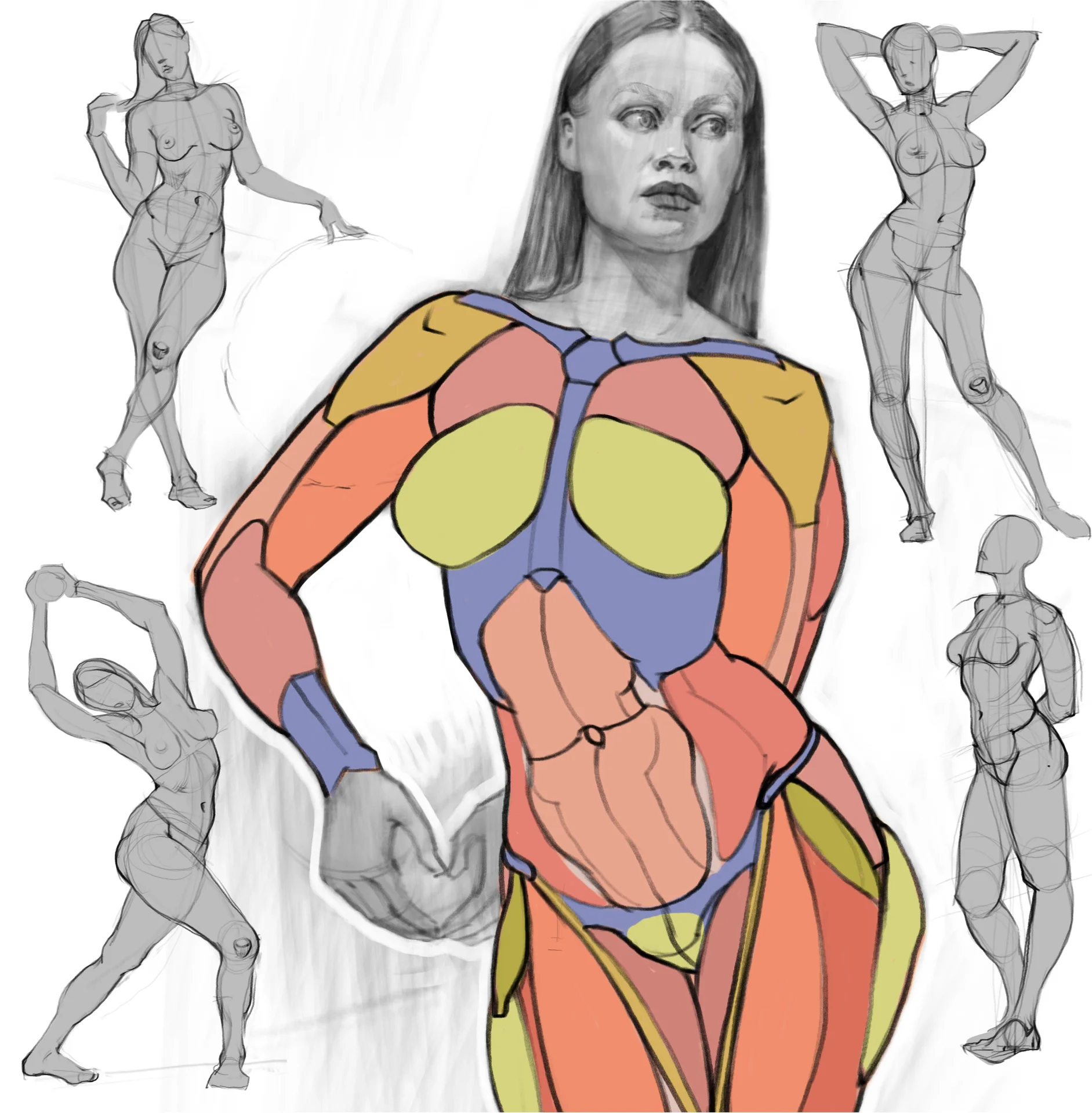
from 3 750 ₽
-25%
My first figure
5 000 ₽3 750 ₽
Learn more

from 4 950 ₽
-45%
Book illustration: The first page
9 000 ₽4 950 ₽
Learn more

from 4 950 ₽
-45%
Prop concept: render and atmosphere
9 000 ₽4 950 ₽
Learn more
And now we will find the proportions of the width of the leg, shelf and protruding part of the seat to each other. In the same way, we draw additional lines that duplicate the movements of the edges of the stool details. We measure the small widths to the largest one - the shelf between the legs. We get the following proportions:
 So you can measure the proportions of the details of each other not only in furniture, but also in cars, plants, architecture and the human body.
 Let's look at the first figure: relatively the head it is also convenient to measure the width of the shoulders and pelvis. The height of the head fits twice into the height of the shoulders. But the width of the pelvis is a purely unique thing for each person. However, it is convenient to measure it with the same height of the head, and for this girl it also fits twice into the width of the hips. And now let's look at the second figure and compare the width of the shoulders and the width of the hips, since they can have different volumes or be equal. There is no indisputable coefficient for them, they need to be compared situationally. For girls, the width of the hips is often greater than the width of the shoulders, and vice versa for men. As for our mademoiselle, the shoulders turned out to be narrower than the hips by a slight difference.
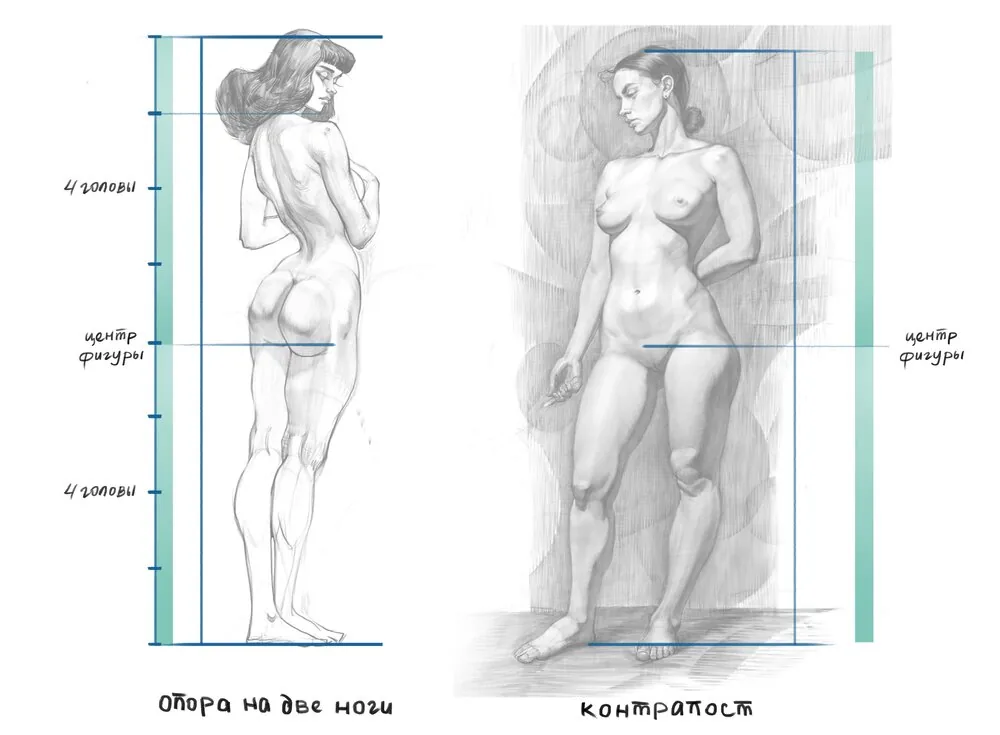
 The next proportion that every drawer should know about is the center of the figure. If you divide the vertical axis in half, you will get into the center of the pubic area, which is the center of the figure. For a figure with two points of support, the upper half of the body axis and the lower half fit 4 heads each. For a figure in the contraposto position, there is a slight shift in these proportions.
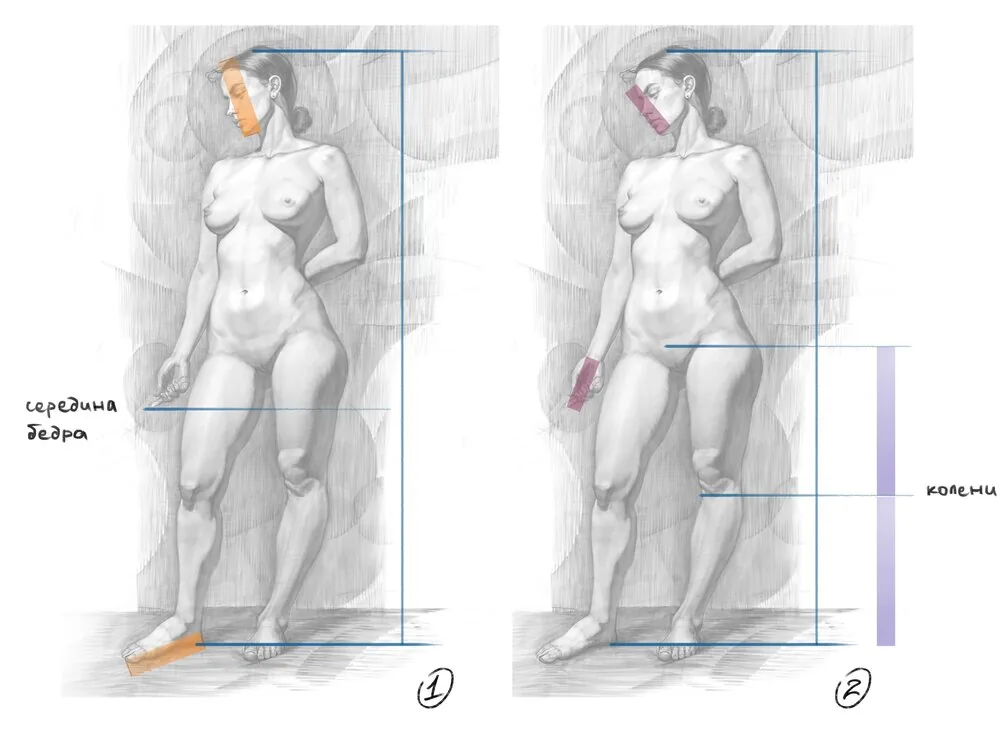
 If you divide the lower part of the body in half, you will get into the knee joint - 2. And the hand lowered down will touch the middle of the thigh - 1. Two opposite limbs also have some similarity. And yes, we are talking about the head and the foot: the height of the head is equal to the length of the foot from the heel to the edge of the fingers. It might seem that the palm is deprived of such a proportion, but it also has some pattern of sizes with the head: it fits from the edge of the chin to the middle of the forehead.
 These basic proportions are used by many artists to create sketches, long studies, long sheets with complex rendering and even illustrations.
A beautiful mademoiselle, whom you and I have examined, was drawn by Azat Nurgaleev - the founder of the Skills Up School school together with students on the course “The Human Figure”. If you have always wanted to understand how a person is structured, what proportions need to be observed to create a convincing figure, how to use shading and convey volume, then this course will give you a huge block of useful information and help you learn how to draw a person. Such a complex, but at the same time so simple.
Well, we are moving on and talking about the proportions of an important element of a person - the head. After all, it plays the most important role in the body - it eats!
These basic proportions are used by many artists to create sketches, long studies, long sheets with complex rendering and even illustrations.
A beautiful mademoiselle, whom you and I have examined, was drawn by Azat Nurgaleev - the founder of the Skills Up School school together with students on the course “The Human Figure”. If you have always wanted to understand how a person is structured, what proportions need to be observed to create a convincing figure, how to use shading and convey volume, then this course will give you a huge block of useful information and help you learn how to draw a person. Such a complex, but at the same time so simple.
Well, we are moving on and talking about the proportions of an important element of a person - the head. After all, it plays the most important role in the body - it eats!
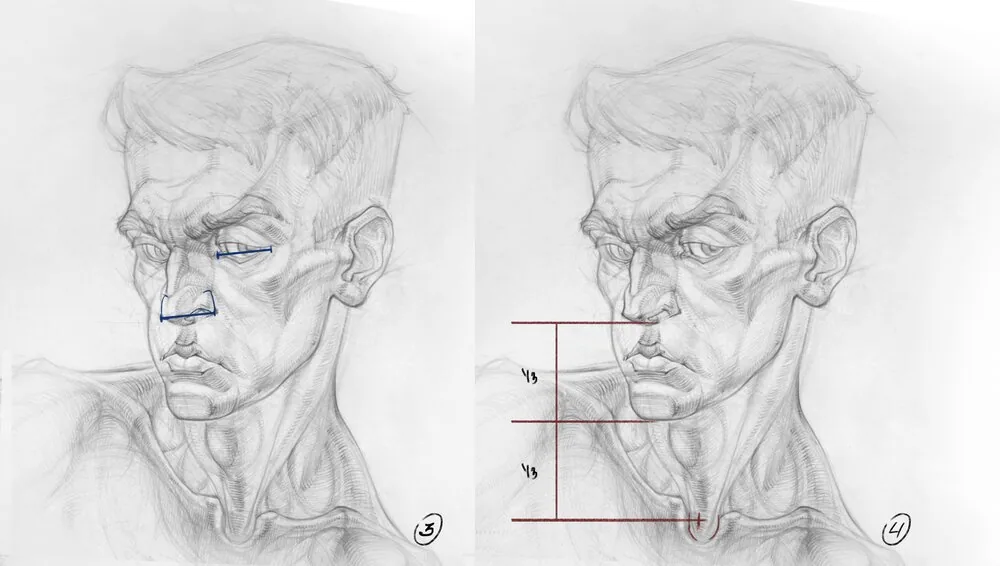
 The width of the eye fits twice into the height of the nose from the base of the cartilage to the fracture of the bridge of the nose - 1. And the corners of the lips in a calm state are on the same horizontal level with the corners of the jaws - 1. Provided that we look at the person frontally, and not in a strong angle. Also, the corners of the lips are on the same vertical with the center of the eye - 2. If our character looked straight ahead, we would see how the axis of the corners of the lips рифмовалась with the center of the pupils. But that's not all: the level of the eyes is the middle of the height of the head from the crown (where the eternal suture passes) to the chin - 2. And the auditory opening is located next to this line.
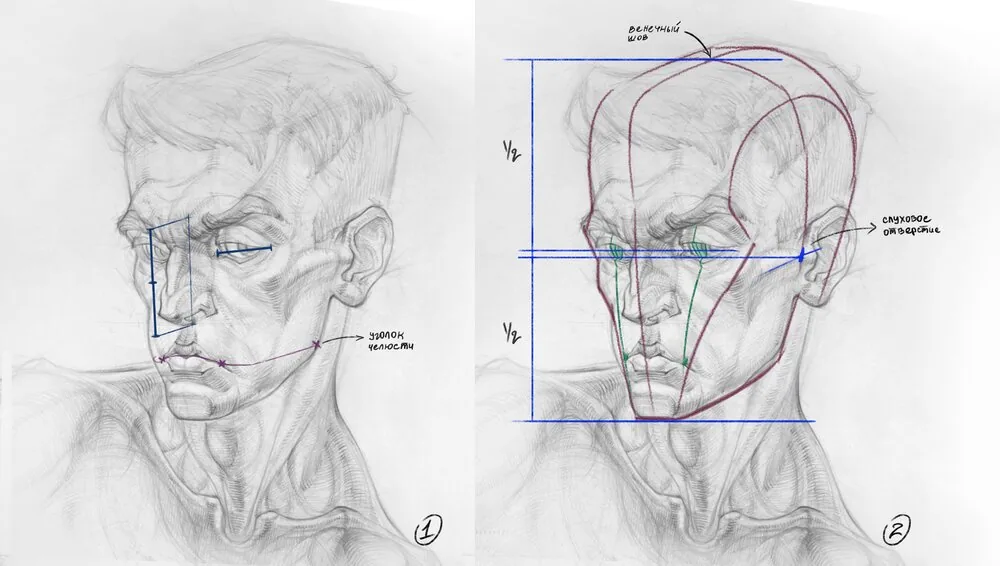 Not only the height of the nose, but also the width of the nose is proportional to the width of the eye. From the edge of the left wing of the nose to the right, the width of the nose is equal to the width of the eye from the tear to the corner of the eyelids - 3. The head exists in space not by itself, it is attached to the body by the neck. And we again find the proportion of two heights: a third of the face is approximately equal to the height of the neck from the chin to the jugular notch - 4. The jugular notch is a small rounded depression between the two collarbones.
 All the external decoration of the head: its nose reliefs, the hills of the eyelids, the bends of the cheekbones, the outline of the auricles - all depend on the internal structure, that is, on the skeleton. For bone is the basis and prima ballerina in the anatomical world. Therefore, we suggest you look at a useful video lesson on how to draw a skull on the channel of our school:
 Let's try to compare the width of the shoulders and pelvis with the head. If an adult's shoulders are often equal to two heights of the head, then children's shoulders are narrower, the head fits completely only 1 time. The same thing happens with the pelvis: in the girl above we found a similar proportion, the same as the ratio of the head to the shoulders. And our boys' heads are clearly larger than all other parts of the body: the width of the pelvis is equal to the height of the head.
 Do not forget about the hands and feet and also compare them with the size of the head. And this is an excuse to introduce a new character into the plot of our article - artist Karol Witkowski. Learning from old masters is one of the most beautiful things for a drawer. The child's foot practically fits into the height of the head, and the length of the palm is equal to the distance from the chin to the eyebrow line.
- The width of the leg fits 2.5 times into the width of the shelf
- The width of the protrusion fits 4.5 times into the width of the shelf.
So you can measure the proportions of the details of each other not only in furniture, but also in cars, plants, architecture and the human body.
Proportions of the human figure in the drawing
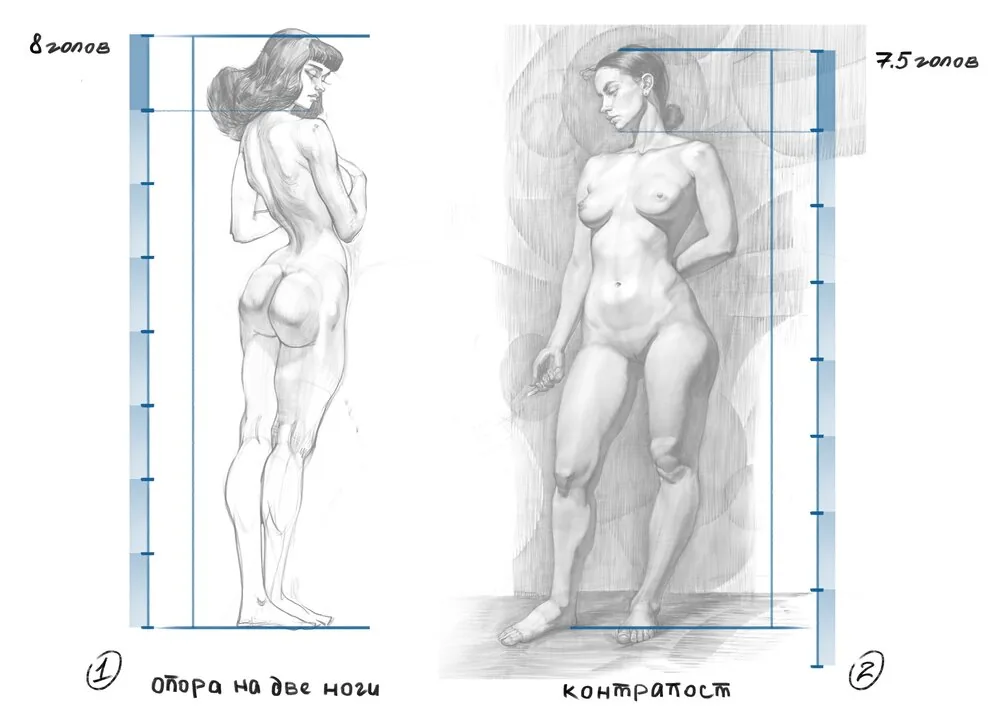
A long time ago, in the times of Ancient Greece, sculptor Polykleitos discovered a system of proportions of the human body, which we still use. Let's look at the basic proportional ratios of our body. The human head is a rigid stable structure that does not stretch, does not bend, and therefore it was taken to find proportions in the body. In the height of the human body with support on two legs, the head fits 8 times - 1. And in the position of contraposto (or in other words with support on one leg) the head fits 7.5 times.
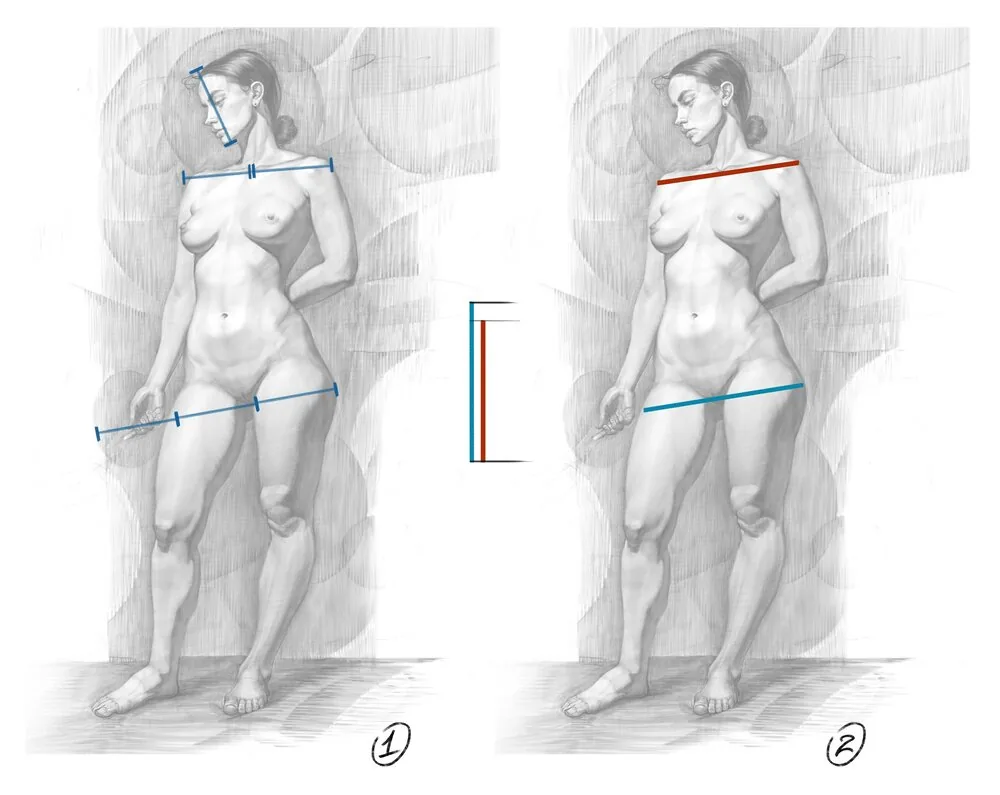
Let's look at the first figure: relatively the head it is also convenient to measure the width of the shoulders and pelvis. The height of the head fits twice into the height of the shoulders. But the width of the pelvis is a purely unique thing for each person. However, it is convenient to measure it with the same height of the head, and for this girl it also fits twice into the width of the hips. And now let's look at the second figure and compare the width of the shoulders and the width of the hips, since they can have different volumes or be equal. There is no indisputable coefficient for them, they need to be compared situationally. For girls, the width of the hips is often greater than the width of the shoulders, and vice versa for men. As for our mademoiselle, the shoulders turned out to be narrower than the hips by a slight difference.
The next proportion that every drawer should know about is the center of the figure. If you divide the vertical axis in half, you will get into the center of the pubic area, which is the center of the figure. For a figure with two points of support, the upper half of the body axis and the lower half fit 4 heads each. For a figure in the contraposto position, there is a slight shift in these proportions.
If you divide the lower part of the body in half, you will get into the knee joint - 2. And the hand lowered down will touch the middle of the thigh - 1. Two opposite limbs also have some similarity. And yes, we are talking about the head and the foot: the height of the head is equal to the length of the foot from the heel to the edge of the fingers. It might seem that the palm is deprived of such a proportion, but it also has some pattern of sizes with the head: it fits from the edge of the chin to the middle of the forehead.
These basic proportions are used by many artists to create sketches, long studies, long sheets with complex rendering and even illustrations.
A beautiful mademoiselle, whom you and I have examined, was drawn by Azat Nurgaleev - the founder of the Skills Up School school together with students on the course “The Human Figure”. If you have always wanted to understand how a person is structured, what proportions need to be observed to create a convincing figure, how to use shading and convey volume, then this course will give you a huge block of useful information and help you learn how to draw a person. Such a complex, but at the same time so simple.
Well, we are moving on and talking about the proportions of an important element of a person - the head. After all, it plays the most important role in the body - it eats!
Drawing the face in proportions
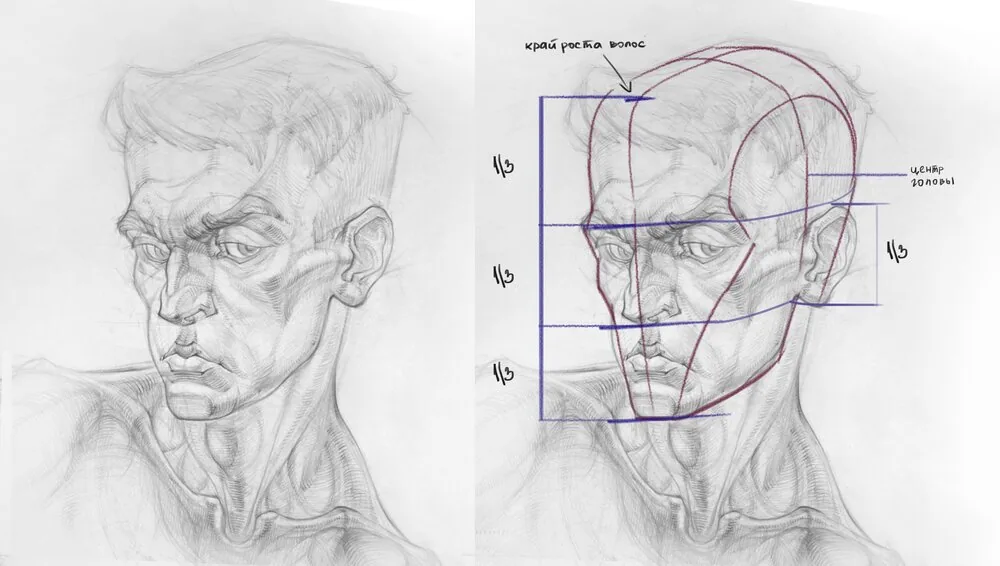
We just looked with you that everything starts with the head. And it turned out to be the head, all measurements of the body start from it. And now let's look at it in more detail, because there are so many details on it! Eyes, ears, nose, mouth, cheekbones, hair were not thrown on it by some farmer with a random wave of his hand. There is a pattern in everything. Let's take student Nikita Petrov's drawing as a basis. We draw a vertical axis on the front of the facial mask and on the side surface. On the side of the face, this axis will be the center of the head. And in front we will find three more quantities. We mark the edge of hair growth. From the hair growth point to the chin, the axis can be divided into 3 equal parts: from the edge of the hair growth to the eyebrows, from the eyebrows to the base of the nose and from the base of the nose to the chin. Very aptly, the ear is рифмованный with the central third of the face.
The width of the eye fits twice into the height of the nose from the base of the cartilage to the fracture of the bridge of the nose - 1. And the corners of the lips in a calm state are on the same horizontal level with the corners of the jaws - 1. Provided that we look at the person frontally, and not in a strong angle. Also, the corners of the lips are on the same vertical with the center of the eye - 2. If our character looked straight ahead, we would see how the axis of the corners of the lips рифмовалась with the center of the pupils. But that's not all: the level of the eyes is the middle of the height of the head from the crown (where the eternal suture passes) to the chin - 2. And the auditory opening is located next to this line.
Not only the height of the nose, but also the width of the nose is proportional to the width of the eye. From the edge of the left wing of the nose to the right, the width of the nose is equal to the width of the eye from the tear to the corner of the eyelids - 3. The head exists in space not by itself, it is attached to the body by the neck. And we again find the proportion of two heights: a third of the face is approximately equal to the height of the neck from the chin to the jugular notch - 4. The jugular notch is a small rounded depression between the two collarbones.
All the external decoration of the head: its nose reliefs, the hills of the eyelids, the bends of the cheekbones, the outline of the auricles - all depend on the internal structure, that is, on the skeleton. For bone is the basis and prima ballerina in the anatomical world. Therefore, we suggest you look at a useful video lesson on how to draw a skull on the channel of our school:
Proportions of a child in the drawing
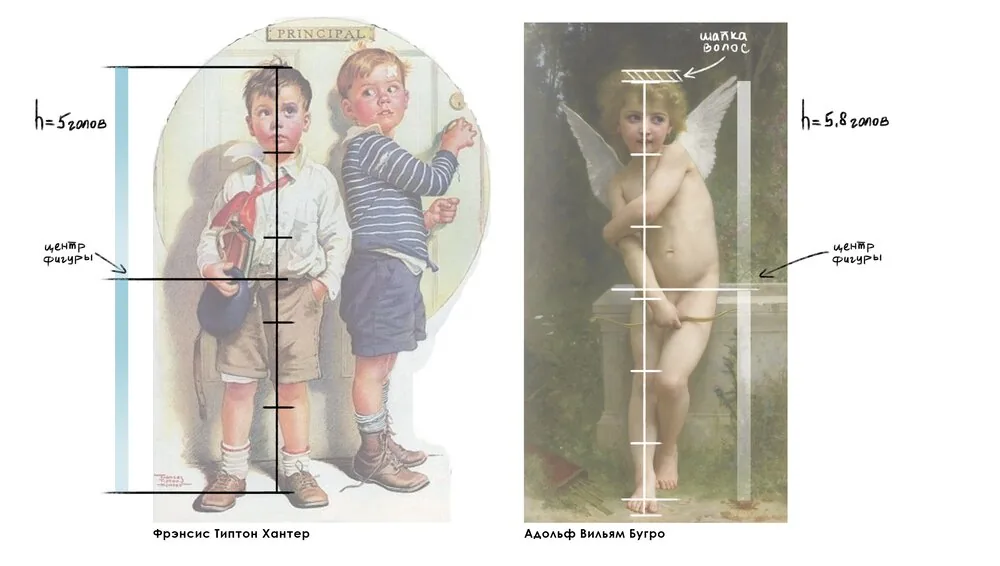
A child's body is constantly growing and changing all the time. The older the child becomes, the closer the proportions of his body become to the body of an adult. Francis Tipton Hunter often drew illustrations with children. He can be called a guru of children's proportions, let's take a look at one of his illustrations and figure out how the proportions of a child's body differ from an adult one. Well, why not add a third judge for comparison? Let's take a second reference for study - Cupid by Adolphe William Bouguereau. The basis of any painting is always a drawing, so we can safely study paintings for the needs of the drawer. On the left are two younger boys, and on the right is Cupid older. Let's see what the ratio of the head to the height of the body is in children of approximately 5 and 9 years of age. The boy on the left has a head that fits 5 times into the height of the body, the center of the figure is shifted closer to the navel. Cupid has a body height that is approximately 5.8 heads, and the center of the body descends into the lower press area. And if Cupid straightens up and stands up straight, then most likely his head will fit into the body all full 6 times. Thus, we can track the gradual approach of the proportion of the head and body of the child to adulthood.
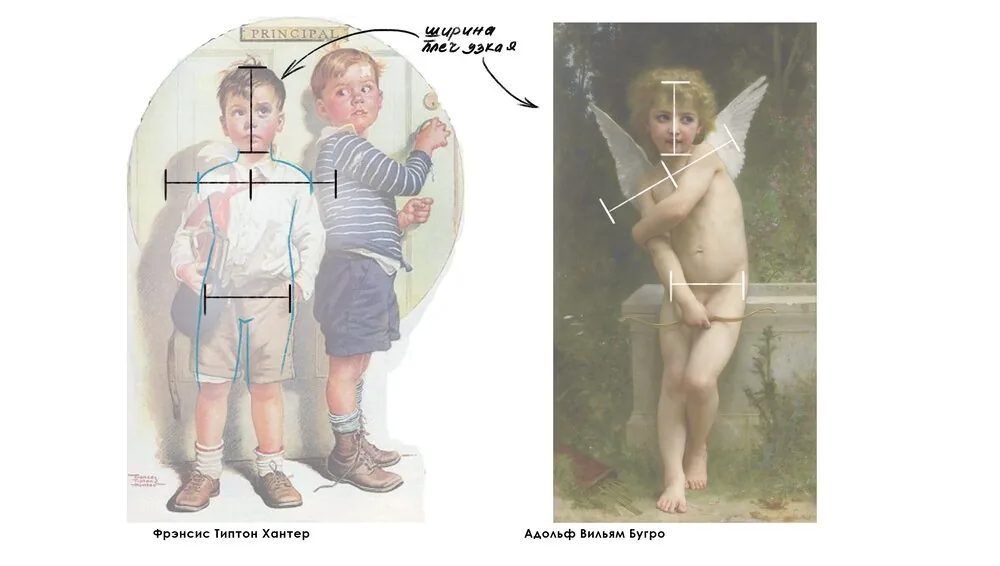
Let's try to compare the width of the shoulders and pelvis with the head. If an adult's shoulders are often equal to two heights of the head, then children's shoulders are narrower, the head fits completely only 1 time. The same thing happens with the pelvis: in the girl above we found a similar proportion, the same as the ratio of the head to the shoulders. And our boys' heads are clearly larger than all other parts of the body: the width of the pelvis is equal to the height of the head.
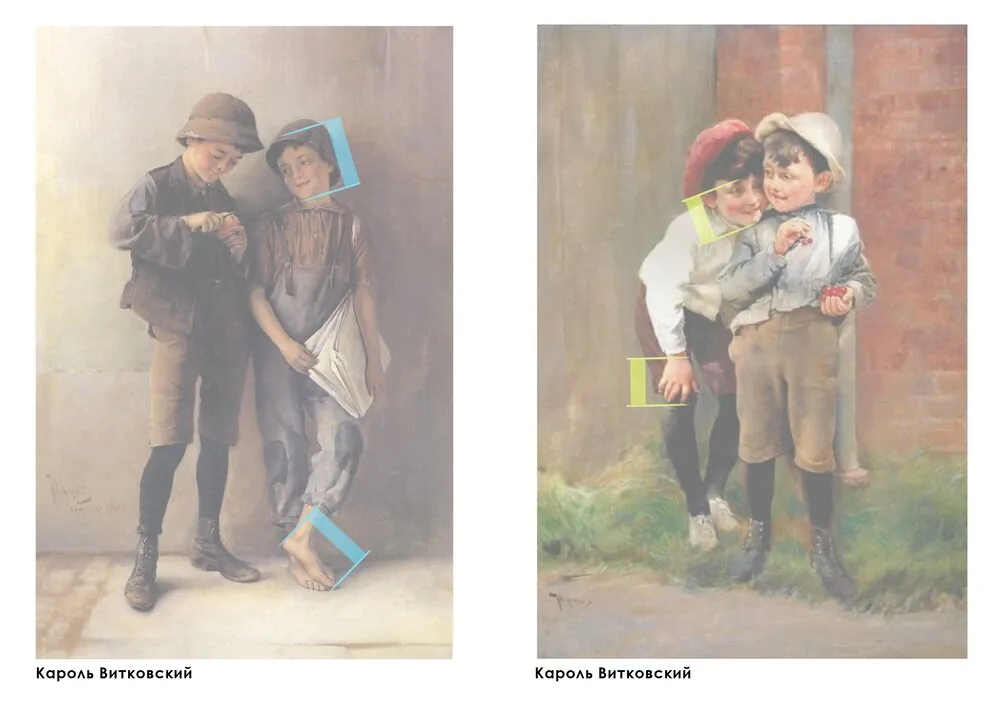
Do not forget about the hands and feet and also compare them with the size of the head. And this is an excuse to introduce a new character into the plot of our article - artist Karol Witkowski. Learning from old masters is one of the most beautiful things for a drawer. The child's foot practically fits into the height of the head, and the length of the palm is equal to the distance from the chin to the eyebrow line.
How to observe proportions in a drawing
It would seem that everything is very simple: draw normally - it will be fine. But we know that this is not the case, and that's why we have collected for you 5 tips on how to observe proportions in drawing:- Measure objects
- Develop your eye
- Stick to your chosen strategy
- Compare different things
- Memorize the proportions you find
Related materials

Article
Frontal perspective in drawing
October 1, 2025
Article
Where is applied drawing used?
September 18, 2023
Article
Statics and dynamics in drawing: creating mood and movement
March 24, 2025

Article
All about brushes in digital drawing
February 13, 2025
Article
Stylization in drawing
January 27, 2025
Tutorial
Chiaroscuro in drawing
December 17, 2024