
ArticleUpdated: September 6, 2026
Texture and finish in the drawing
In short
Surface quality is the character of the material itself; texture is the pattern on it. How to convey wood, metal, fabric, glass and skin with stroke and mass, how matte differs from glossy, how to draw transparency and how surface works in a composition.

2D artist (illustrator)
In a drawing, it is important not only to convey volume, depth, space, and proportions, but also to create the feeling that the material of an object corresponds to its nature. For glass to look glass-like, wood to look wooden, and tin to look tinny. Texture and materiality can help us in conveying materiality, but first we need to get to know them better.
Texture and materiality — like the two Scottish clans, MacIntosh and Mackenzie. They may seem similar, but there are important differences between them. And the main thing is not to allow вражды between them. Let's figure out these differences to maintain harmony in our drawings.

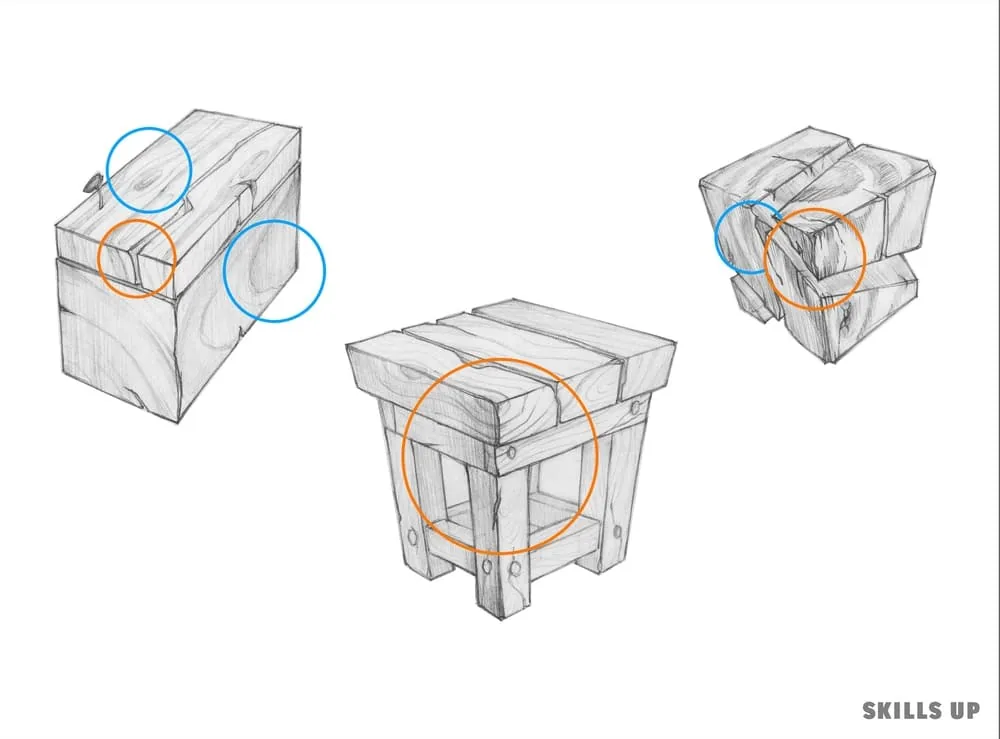 Darya Kostomarova's work, Basic Drawing course.
For example, materiality is highlighted in orange, texture in blue. Pay attention to the materiality of the boards, chips, and cracks. And to the rather even texture of the boards with a pattern of wood fibers.
Darya Kostomarova's work, Basic Drawing course.
For example, materiality is highlighted in orange, texture in blue. Pay attention to the materiality of the boards, chips, and cracks. And to the rather even texture of the boards with a pattern of wood fibers.
What is the difference between texture and materiality
Texture and materiality are two terms that are often used in artistic practice, they are very similar, but they have their own characteristics.- Materiality is the tactile characteristic of the surface of an object. It determines how the object feels to the touch: rough or smooth, prickly or soft. Materiality can be perceived not only visually, but also physically, when the viewer can imagine how the surface will feel when touched.
- Texture is the pattern or design on the surface of an object. It includes details such as wood fibers, stripes, speckles, and other elements that create visual interest and complexity. Texture serves to convey the visual qualities of a surface, not necessarily related to its tactile properties.
Perception
Materiality is perceived directly through touch and vision. For example, you can feel that the surface of a stone is rough, and velvet is soft. Texture is determined by how the surface looks. For example, in a picture you can see how light is reflected on smooth glass or how the fibers of the fabric look.Means of expression
To create materiality, artists use various techniques, such as layering, texture pastes, or special tools to convey the physical qualities of the surface. Texture can be conveyed through strokes, brushstrokes, or details that depict patterns and designs. Different techniques can create a variety of visual effects that emphasize the texture of the object.Function in art
Materiality helps to create a realistic representation of objects and enhances the feeling of physical presence. This makes the work more voluminous and tangible. Texture adds interest to the visual perception and can serve as a means of focusing attention on certain elements of the drawing. For example, texture can emphasize the contrast between different parts of the composition, creating dynamics and depth.
Darya Kostomarova's work, Basic Drawing course.
For example, materiality is highlighted in orange, texture in blue. Pay attention to the materiality of the boards, chips, and cracks. And to the rather even texture of the boards with a pattern of wood fibers.
Drawing texture and materiality according to the shape
Related courses
All courses
from 3 750 ₽
-25%
My first figure
5 000 ₽3 750 ₽
Learn more

from 4 950 ₽
-45%
Book illustration: The first page
9 000 ₽4 950 ₽
Learn more

from 4 950 ₽
-45%
Prop concept: render and atmosphere
9 000 ₽4 950 ₽
Learn more
When creating a drawing, it is important to consider the shape of the object. Texture can be conveyed through lines and strokes that visually display its surface. For example, to depict a rough surface, you can use short, uneven lines. But wrapping around the shape of the object, the texture often does not have any significant changes. Materiality, on the other hand, requires more attention to dynamics and expression. Wrapping around the shape of the object, materiality becomes more noticeable on various bends. We see chips on the corners of plaster figures, depressions in wooden boards, etc.
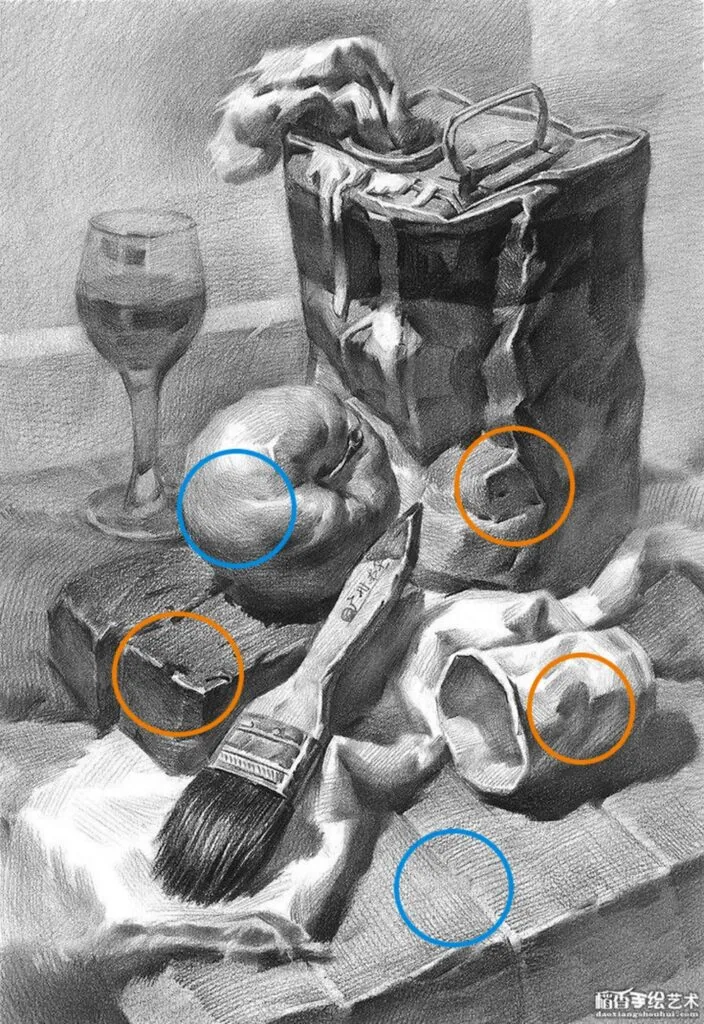 On this example, it is clearly seen how materiality is actively expressed on the bends, turns, and corners of objects. A chip in the stone, crumpled metal on the canister, and dents on the cup are especially noticeable in places where the shape changes. Texture, on the other hand, can cover the entire surface of the object and is easily readable even on a flat plane.
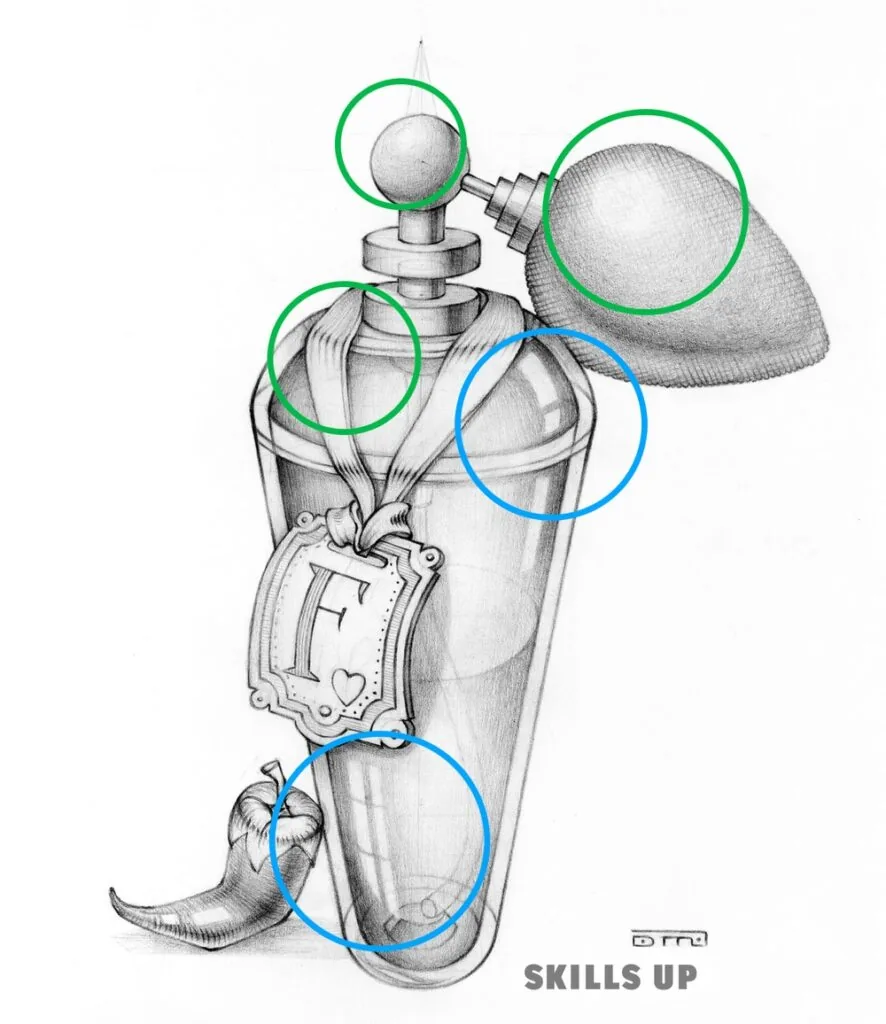 Maria Marchenko's work, Basic Drawing course.
Blue color highlights clear highlights on the glass, which gives it glossiness. Green - matte surfaces of the bottle cap, sprayer, and ribbon. Highlights on these parts are softer, and on the ribbon they are completely invisible.
Maria Marchenko's work, Basic Drawing course.
Blue color highlights clear highlights on the glass, which gives it glossiness. Green - matte surfaces of the bottle cap, sprayer, and ribbon. Highlights on these parts are softer, and on the ribbon they are completely invisible.
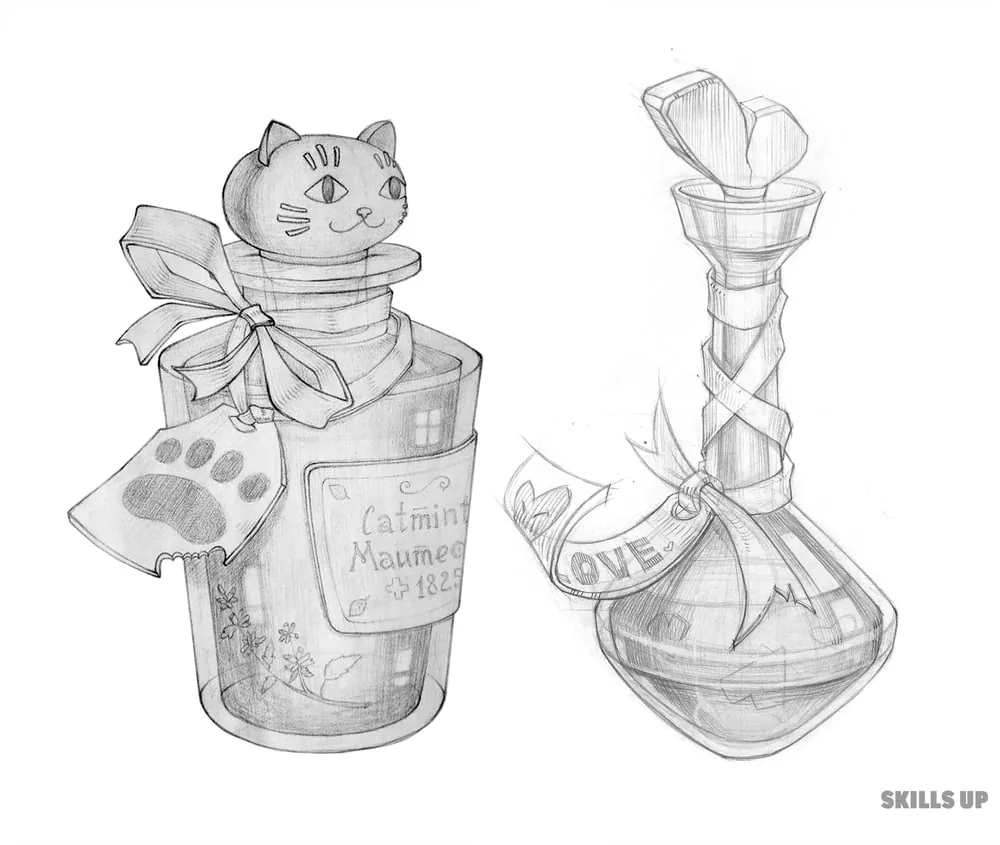 Works by Vera Malysheva and Valeria Zagoruyko, Basic Drawing course.
Pay attention to how the flower is visible inside the left bottle. And in the right bottle you can see floating hearts and the level of the liquid.
Works by Vera Malysheva and Valeria Zagoruyko, Basic Drawing course.
Pay attention to how the flower is visible inside the left bottle. And in the right bottle you can see floating hearts and the level of the liquid.
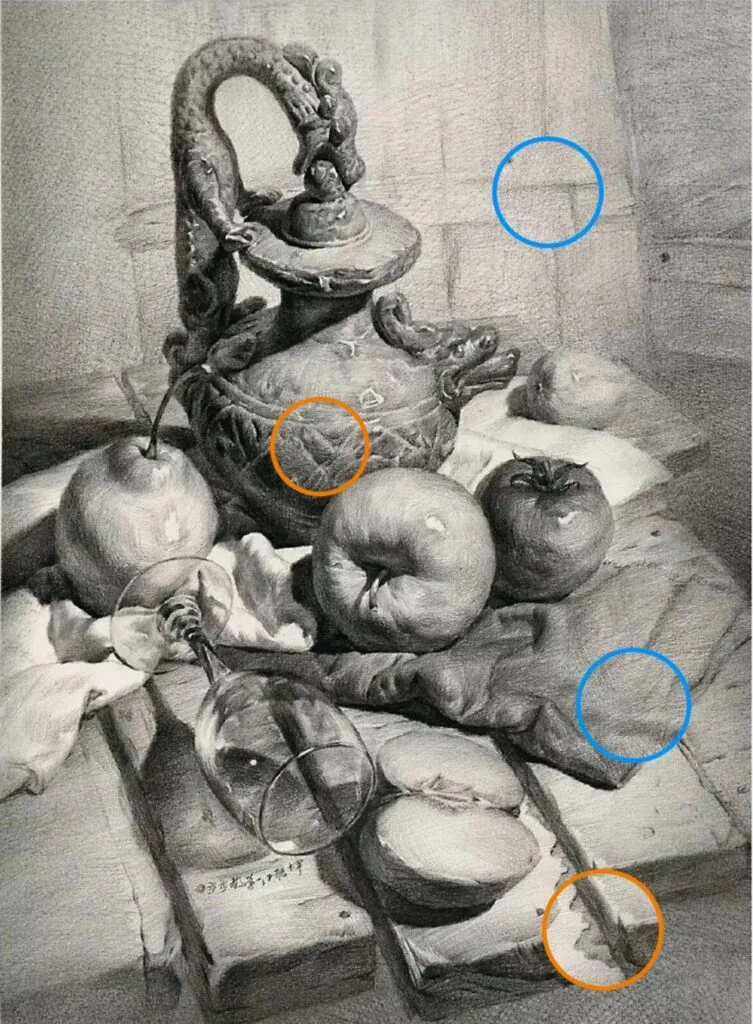 Material details in the foreground and on objects important for the composition, such as a vase, attract the viewer's attention. More calm textures of wood in the background and fabrics on the table serve as a background. This combination does not allow the picture to become fractional.
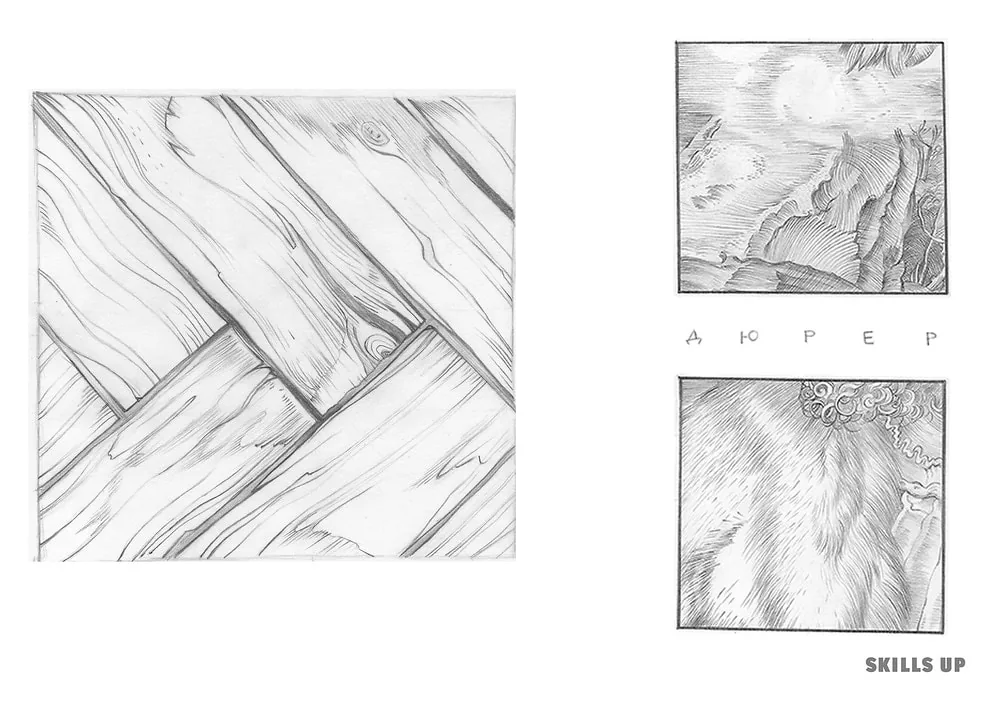 Works by Sofya Byvsheva and Vera Lositskaya, Basic Drawing course.
On this example, it is clearly seen how materiality is actively expressed on the bends, turns, and corners of objects. A chip in the stone, crumpled metal on the canister, and dents on the cup are especially noticeable in places where the shape changes. Texture, on the other hand, can cover the entire surface of the object and is easily readable even on a flat plane.
Matteness and glossiness when creating texture and materiality
Matteness and glossiness play an important role in conveying texture. Glossy objects are characterized by high reflective properties, clear-shaped highlights, and deep, contrasting shadows and reflections. Matte surfaces, on the contrary, scatter the light falling on them. Highlights on such a surface are soft, without clear edges, and reflections are very weak, barely noticeable, or absent altogether.
Maria Marchenko's work, Basic Drawing course.
Blue color highlights clear highlights on the glass, which gives it glossiness. Green - matte surfaces of the bottle cap, sprayer, and ribbon. Highlights on these parts are softer, and on the ribbon they are completely invisible.
How to depict transparency
Depicting transparency in a drawing requires a special approach. For this, you can use thin lines and soft transitions of tone. Transparent objects, such as glass or water, create complex light and shadow effects, and the artist must be able to convey these nuances to achieve realism. Other details and objects are visible through transparent objects, this can also be used. Show how some elements are visible behind the vessel or its internal details (tube/glass bottom/relief). Maybe there is an object inside? Consider the thickness of the transparent surface and its purity. Is this glass thick or thin? Clean or dusty? Dark or colorless? These factors also affect transparency. Using layering and semi-transparent tones helps to create the illusion of transparency.
Works by Vera Malysheva and Valeria Zagoruyko, Basic Drawing course.
Pay attention to how the flower is visible inside the left bottle. And in the right bottle you can see floating hearts and the level of the liquid.
Materiality in composition
Materiality in the composition of a drawing plays an important role, as it adds depth and expressiveness. Here are some basic aspects of the influence of materiality on the composition: Creating accents: Materiality can highlight certain elements in the drawing, directing the viewer's gaze to them. For example, rough materiality can attract attention, while smooth areas can serve as a background. Emotional load: Different materialities evoke different emotional responses. Smooth lines can be associated with something calm and pacifying, while sharp and ragged textures can convey tension or dynamics. Contrast and rhythm: The use of various materialities can create a contrast that enlivens the composition. Rhythmic alternation of materialities helps to keep the viewer's attention and makes the image more dynamic. Depth and space: Materiality can be used to create the illusion of volume and depth. More material areas will come to the fore, and less elaborated ones - to the back. Style and character: Different materialities can emphasize the style of work. In a realistic drawing, materiality can be detailed, while in an abstract one - more stylized or schematic. Interaction with material: Different techniques and materials (charcoal, watercolor, pastel) create unique materialities, which also affects the overall composition. Materiality can significantly influence the overall composition of a drawing. It attracts attention to certain areas of the work. The correct distribution of material and smooth elements can direct the viewer's gaze and create a certain mood. In addition, the contrast between materialities can serve as a means of accentuating important details and elements.
Material details in the foreground and on objects important for the composition, such as a vase, attract the viewer's attention. More calm textures of wood in the background and fabrics on the table serve as a background. This combination does not allow the picture to become fractional.
Stroke and materiality
Stroke is one of the main tools for conveying tone, creating texture and materiality in a drawing. Different hatching techniques, such as cross-lines, dot hatching, or wavy lines, can convey a variety of textures and effects. Playing with light and shadow achieved with the help of a stroke add depth and volume. Exercises on copying textures and materialities of various materials will help you find your approach to achieve the effect you want in the drawing. By the way, we do such exercises in the course Basic Drawing ;)
Works by Sofya Byvsheva and Vera Lositskaya, Basic Drawing course.
Conclusion
Texture and materiality are among the most important tools in an artist's arsenal. Understanding the differences between them will help you more accurately and realistically convey your ideas in a drawing. Practicing skills in working with line, tone, stroke, and conveying textures will help you masterfully convey various materials on paper and in digital format. And to make progress faster, we invite you to Drawing courses at Skills Up, where under the sensitive guidance of curators, in a creative and supportive atmosphere, you will create cool works and improve your knowledge. Experiment with techniques and techniques, draw boldly, let each stroke become a step towards new creative heights!Related materials

Article
Frontal perspective in drawing
October 1, 2025
Article
Where is applied drawing used?
September 18, 2023

Article
Statics and dynamics in drawing: creating mood and movement
March 24, 2025

Article
All about brushes in digital drawing
February 13, 2025

Article
Stylization in drawing
January 27, 2025
Tutorial
Chiaroscuro in drawing
December 17, 2024