How to draw folds and drapery
Learn to draw folds on a clothed figure: silhouette and proportion, the rhythm of folds from points of tension, light and shade on fabric, the accordion fold.

Hello, friends. Today we are drawing a clothed figure and figuring out how folds and drapery work on clothes. I chose a contrasting and expressive reference, and here's the main idea of the lesson: a fold is not a random squiggle. Clothing either emphasizes the figure or builds its own masses, and our task is to show this logic. Therefore, we draw a fold as a shape, through volume and light and shadow, rather than tracing the outline and filling it in.
I didn't choose a contrasting reference by chance: it clearly shows where the fabric fits the body and where it gathers into loose folds, and in such an example, the logic of drapery is most easily understood.
I'm working in Procreate on an iPad, but you can easily repeat the same thing with a pencil on paper. The principle is the same, the tool is any.
What you'll need
Procreate and a stylus, or pencil and paper. Choose a fairly stiff brush; the shape is better visible on it. A soft brush hinders a beginner; everything blurs, and it's unclear where the volume is. I work in layers and squint from time to time: squinting immediately shows where the shape has sagged and where there is a lack of tone.
Silhouette first: start with a small sketch
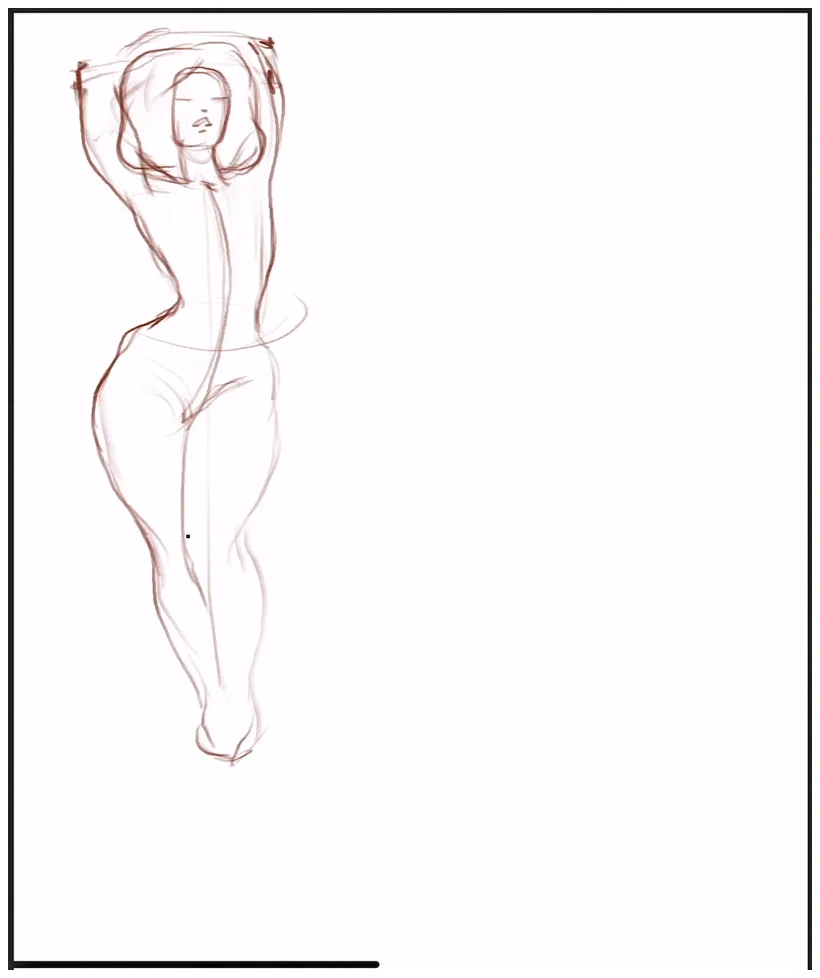
First of all, I catch the silhouette, and I do it in a very small size, about one-fifth of the screen, A6 or even A7 format. A small sketch is needed to better see the overall silhouette and not get bogged down in details. I take the correct proportions gradually, layering, refining. And I immediately keep in mind the trick of a clothed figure: there is not much clothing on it yet, but even this clothing either fits and shows what the figure consists of, or forms its own additional masses. That's what we're working with.
The main rule: clothing either emphasizes the figure or builds its own masses
This is the idea that makes the whole lesson worth watching. When drawing a person in clothes, always ask yourself: what does this fabric do. If it's tight clothing, a T-shirt, crop top, leggings, then the fabric follows the body, and the folds come from the points where it is pressed or stretched. If it's loose drapery, wide pants, dress, coat, then the fabric has its own life and forms its own volumes that only hint at the figure inside. These are two different stories, and they are drawn differently. As long as you keep this in mind, the folds turn out meaningful, not random.
Proportions and contrast: one side is active, the other is soft
Next, I refine the proportions and allow myself some stylised exaggeration. The legs can be slightly elongated, the shin a bit longer, as if we're looking slightly from below, it gives the figure character. But there's a subtle point: the silhouette can't be equally active on both sides. On one side, let the figure be active and elastic, and on the other, soft and pliable. If both sides are shouting, it creates dissonance, and the picture seems ugly. The contrast of active and soft is what makes the pose lively.
Related courses
All courses
My first figure
5 000 ₽3 750 ₽

Book illustration: The first page
9 000 ₽4 950 ₽

Prop concept: render and atmosphere
9 000 ₽4 950 ₽
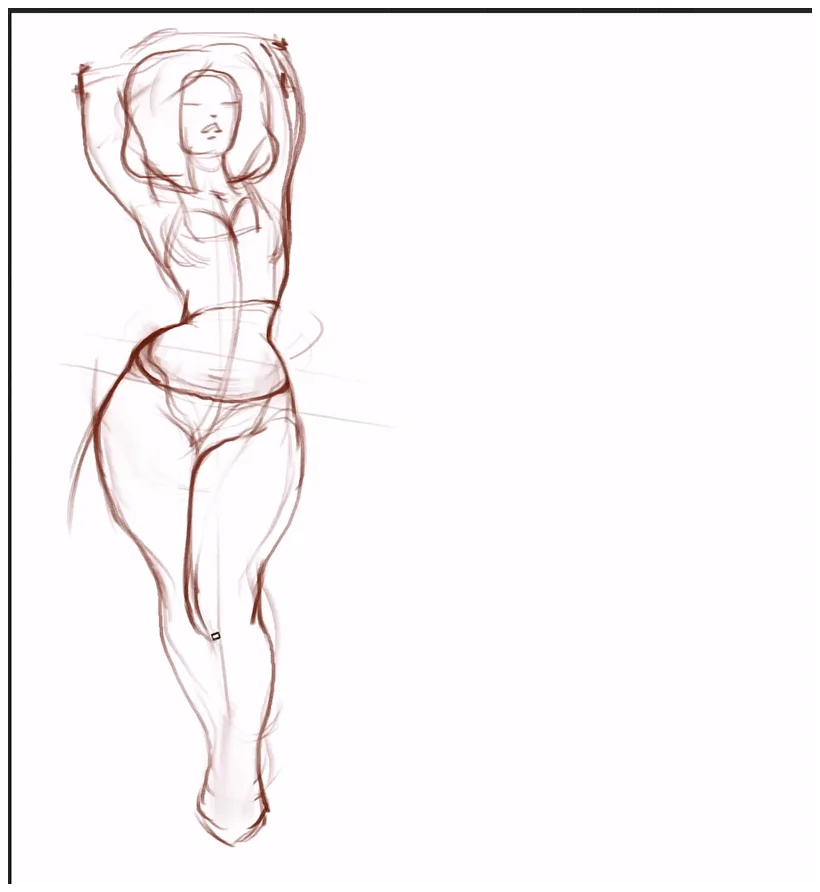
How clothing reacts to the body
Now I'm showing how the fabric responds to the shape. The crop top visibly compresses the figure, so the soft tissues underneath are slightly compressed, and this volume needs to be shown. The chest under the crop top is slightly lifted, and the abdominal muscles are slightly pulled up towards the fabric, and I show this first with a general top layer, then refine it with a second one. The elastic band on the waistband doesn't live on its own; it responds to the stomach and bends along with it. Closer to the waistband, I outline the navel and a small fold above it, such details enliven the stomach. I slightly lower the fit of the pants, and this immediately emphasizes the tilt of the pelvis, the figure comes to life. The sketch at this stage is still a bit rough, and that's normal; in the beginning, it should be a bit dirty. First, we build up mass and logic, then we bring out the cleanliness.
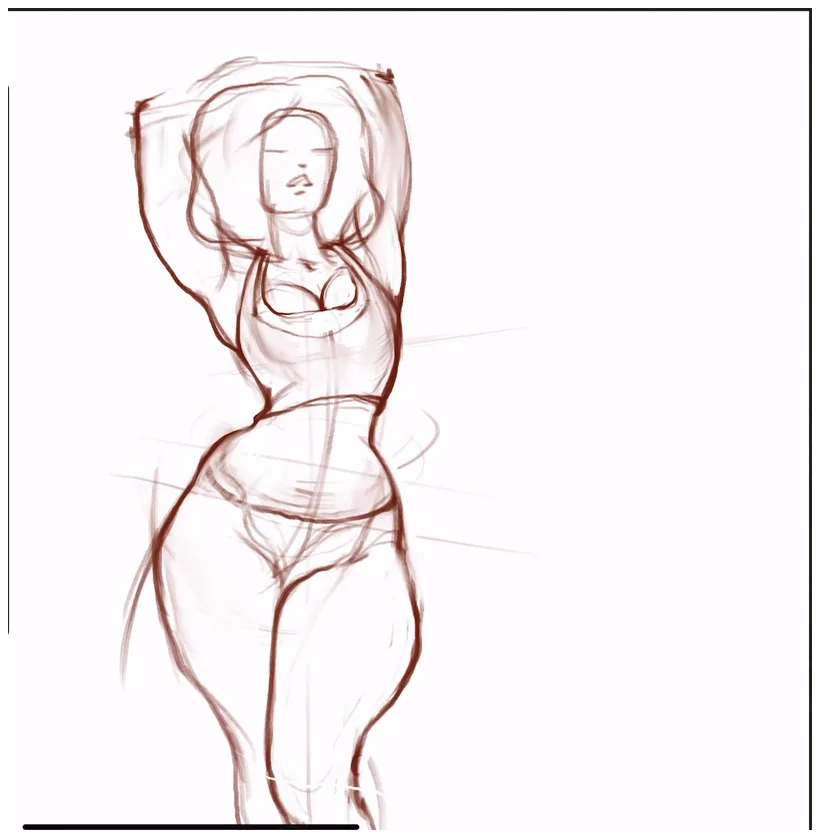
Where the form is not very active, I don't have the right to draw a hard linear contour, soft modeling is needed there. And where there is a clear accent, like the chest or hip, the line can be drawn more confidently. This difference between soft and hard is what reads as skill.
The rhythm of folds and tension points
The most interesting thing about folds is the rhythm. A fold doesn't appear out of nowhere, it has a tension point, and from this point it spreads out. On the knee, we have a joint, and from it, the folds go like rays from the sun, and then they follow an arc, like a soft letter G. I don't copy each fold from the reference one-to-one, I build the rhythm: I strengthen some folds, remove others so that the drawing reads well. This is where the plasticity lies. The more you show the hidden rhythm, the more alive the fabric looks, the more you dwell on each detail, the drier the result.
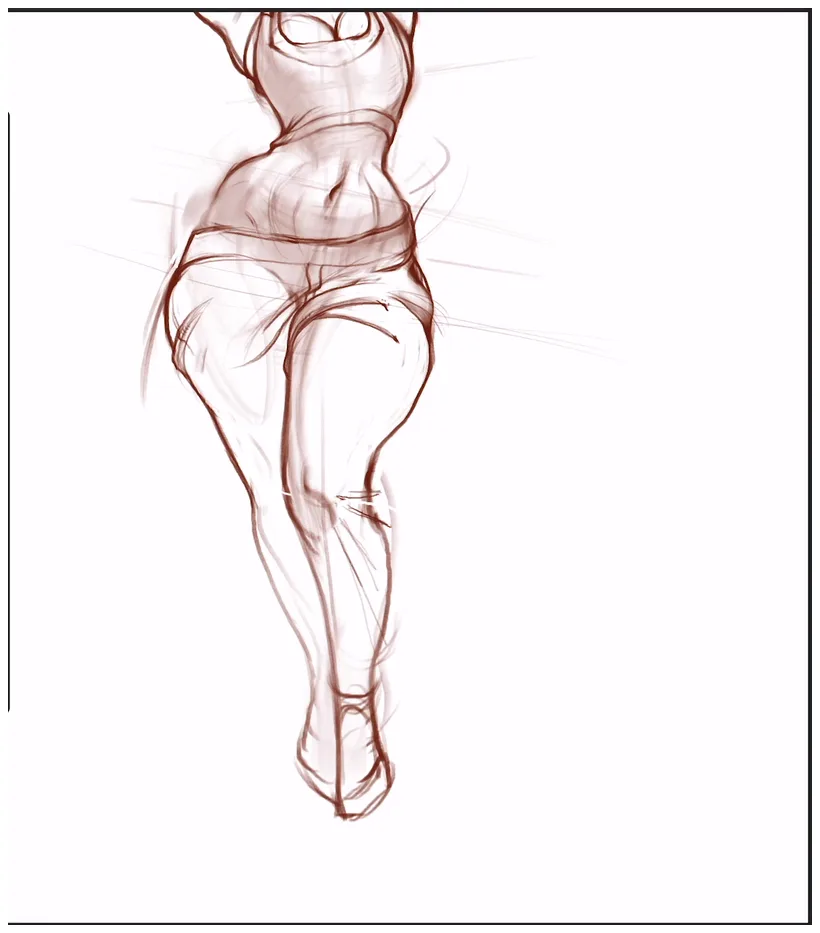
To make the fold look voluminous, I mark its center line and indicate the construction, where the shape goes. Without this logic, the fold turns into an incomprehensible blotch. As soon as volumes and center lines appear, the drawing becomes immediately clear.
Light and shadow: light on the top planes, accordion folds below
The final stage is tone. I create a general light and shadow transition, for example, along the thigh and further to the knee joint, so that the leg looks voluminous. On the folds, I bring out the light on the top planes, where the fabric is closer to the source, and take the lower planes into the shadow. The folds are not straight, they curl, and this needs to be felt. At the bottom, the trouser leg gathers into an accordion at the ankle, and these small folds should not be too active, a little volume is enough. On one side, the fabric is stretched taut, with a straight dynamic line, on the other, it hangs softly. I also include the pocket in the work: it provides detail and additional planning, moves back and curls. And the elastic band at the bottom suggests that the shin is turned away from the viewer. Through such small details, the silhouette conveys maximum information.
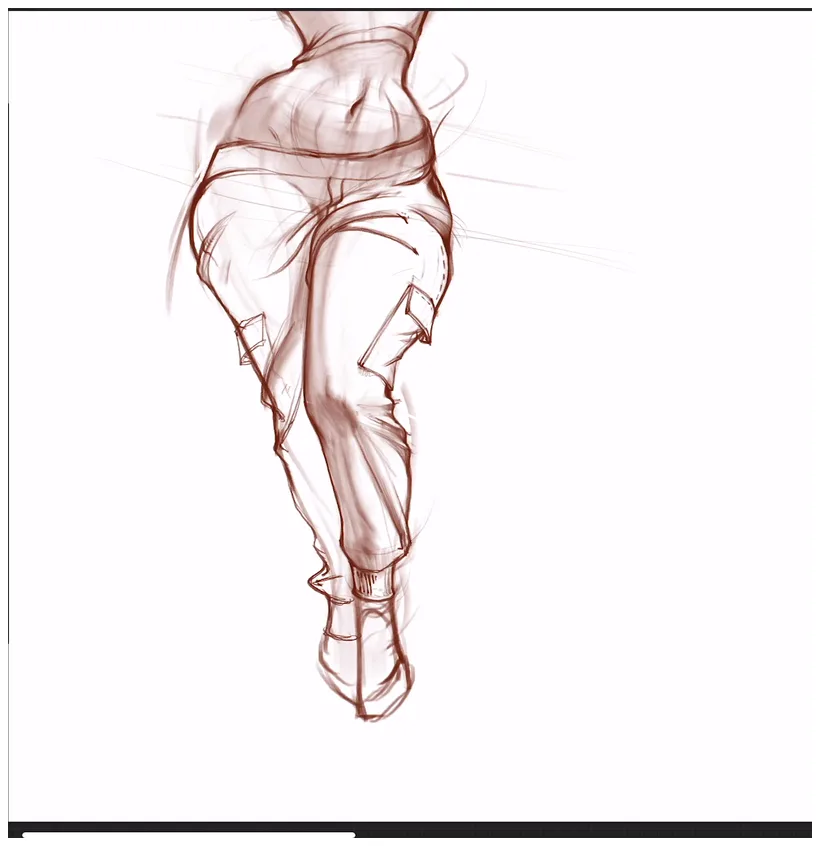
The silhouette should convey maximum information
A skilled artist is a bit cunning: they try to incorporate almost everything into the silhouette. Not only the outer contour of the figure, but also internal silhouettes, individual pant legs, cutouts, elastic bands. The elastic band at the bottom of the pant leg marks the end of the shin and the beginning of the foot, and at the same time suggests that the shin is turned away from the viewer. If you learn to quickly and economically convey maximum information with one silhouette, without unnecessary fuss, that's already a high level. Therefore, when drawing the contour, I constantly ask myself what this piece of the silhouette tells about the shape.
Common mistakes
- Copying folds literally. Without logic and rhythm, a set of lines is not readable. First, the tension point and construction, then details.
- Making both sides of the silhouette active. It results in dissonance. One side is active, the other is soft.
- Fold without construction. If there's no center line and volume, the fold looks like a flat blob.
- Overworking. When you spend hours on each fold, the drawing gets stale. A quick, precise, impactful line is valued higher.
- Gray lifeless shadow and identical edges. Alternate soft and hard edges, then the fabric breathes.
Final advice
There's an unspoken rule in drawing: if a complex task is solved quickly and with minimal means, it's top-notch. Look at how Kim Jung Gi works: a couple of line movements, and there's already a lively, interesting form. That's what we strive for. Draw this figure with me, and then make a couple more sketches with different draperies to reinforce it. Folds are a skill that grows from the volume of practice.