How to Draw a Knee
Learn to draw the knee: the joint from the femur, the head of the tibia and the kneecap, patellar ligaments, condyles, straight and bent positions.

The knee is a joint, not just a bend
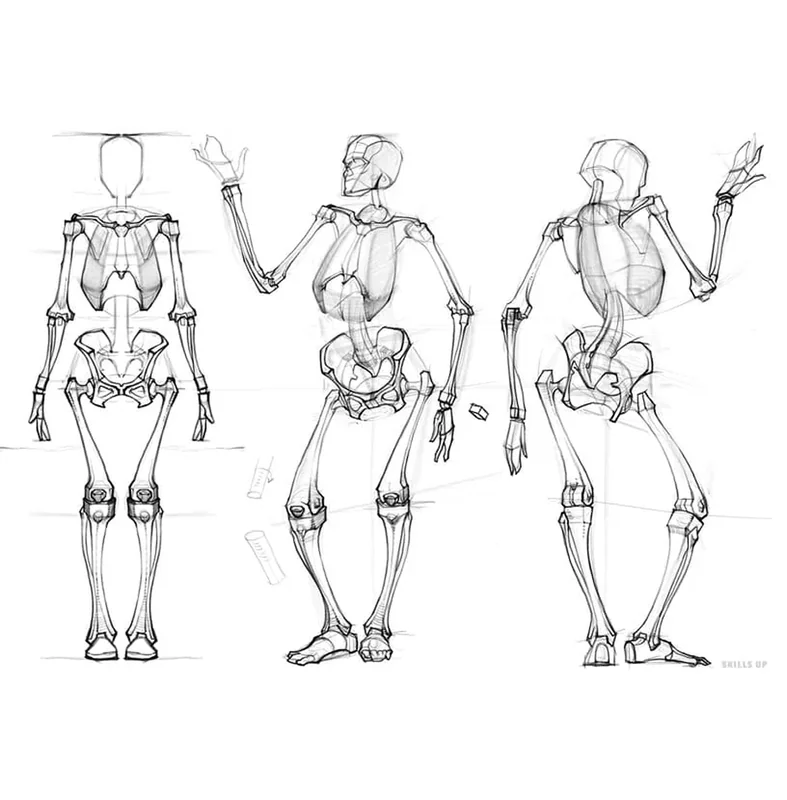
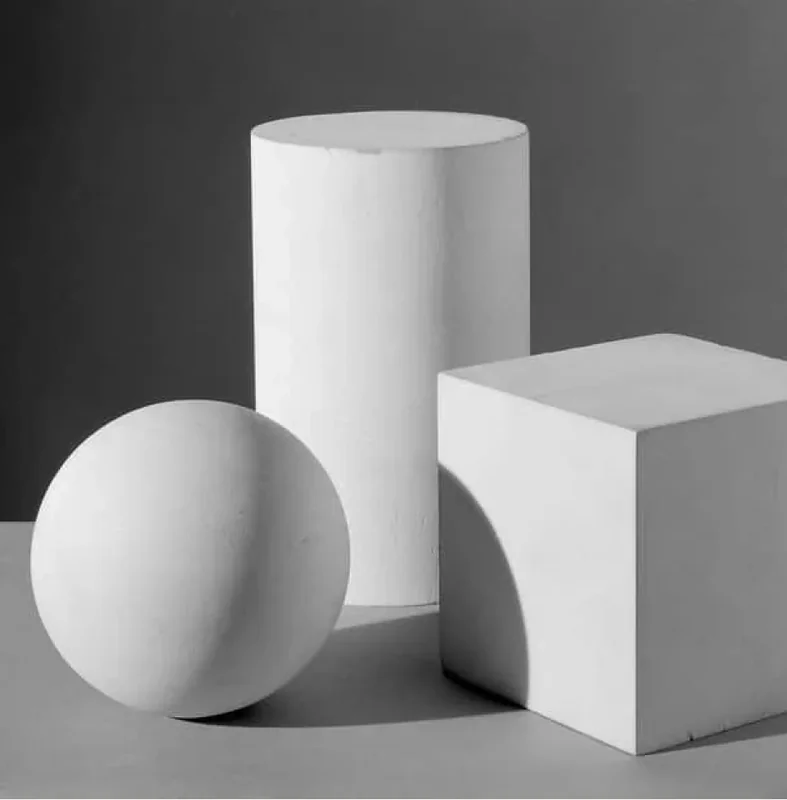
Many people have problems with knees: they draw legs, but the knee turns into a mess. I always explain it as a joint. The leg consists of the thigh and the lower leg, and between them is the knee joint. I keep the thigh as a cube structure, the lower leg as something in between a cylinder and a cube, and the joint itself at the first stage is a ball. The leg has two main positions: straight and bent, and the joint is read differently in them. Therefore, I first put the large shapes, and only then fill them with bones and muscles.
Knee bones: femur, tibial plateau, and patella
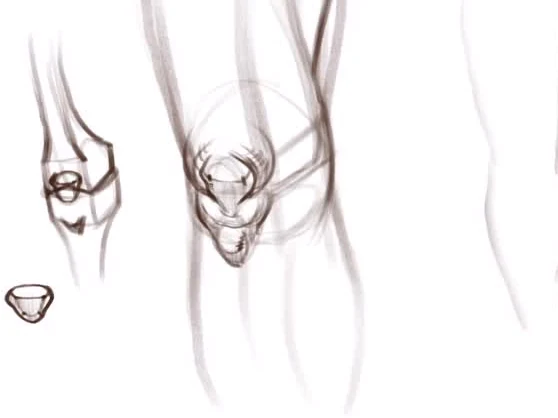
The top of the joint is the lower end of the femur. I draw it as a cam, such a strong volumetric shape. This cam is placed on the tibial plateau. The plateau has a frontal part and a lateral one that goes down, and in the middle sits the tibial tuberosity, to which everything is attached. In the middle of the joint, the patella is inserted. It's not a circle, but a volumetric triangular plate: it has upper, lateral, and lower planes, and the upper one usually catches the light a little more. These three bones are the framework of the knee, on which the muscles lie further.
The patella is held by ligaments
An important point that explains a lot: the patella, also known as the patella, is not directly attached to the bones. It is stretched between the patellar ligament, which goes down to the tibial tuberosity, and the quadriceps tendon from above. When the leg is straight, the patella is movable, moving up, down, and to the sides. When the leg bends, the ligament tightens, stretches the patella, and presses it into the joint to cover this space. On the sides, the joint is held by collateral ligaments that connect the thigh and lower leg to prevent the leg from twisting. Muscles work around the patella: the sartorius stretches from the outer side to the inner and divides the thigh, then the quadriceps with the outer and middle heads, and on the inner side are the adductors. From below, two fat pads protrude from the joint, and together with the tuberosity, they form a triangular structure under the patella, in which the patella sinks slightly.
Related courses
All courses
My first figure
5 000 ₽3 750 ₽

Book illustration: The first page
9 000 ₽4 950 ₽

Prop concept: render and atmosphere
9 000 ₽4 950 ₽
Straight knee
On a straight leg, I show the patella and the tuberosity, and above and below the patella, I build up soft muscle masses: above is part of the quadriceps, below are those same fat pads. Below comes the edge of the tibia, and on the sides, the muscles of the lower leg slightly cover it, so the transition is soft. To understand how the shape wraps, I draw a cross-contour line: it goes along the bone, then goes to the calf muscle and to the muscles of the lower leg. With a stroke, I show where the shape has turned, and slightly outline the heads of the quadriceps, where the outer one starts a little higher on the tendon.
Bent knee
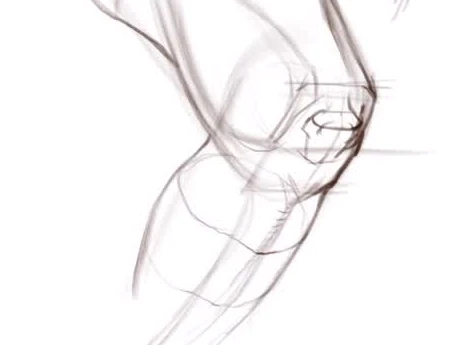
In the bent position, everything changes. I take the ball of the joint, insert the plateau into it, place the femur on top, and instead of a ball, a cube is obtained, on which the patella lies. Along the midline down goes the tuberosity and the edge of the tibia. Here, the patella is the most convex shape, the tip of the wedge, so I reveal it most actively. From the patella comes the main fracture, which divides the thigh from the upper plane to the lateral one. The upper and lower muscle structures that were visible on the straight knee are now hidden and stretched, they are not visible, but the tibial plateau and its frontal part are well read.
Complex angle and condyles
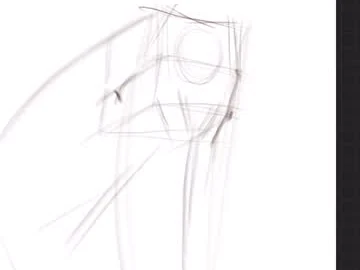
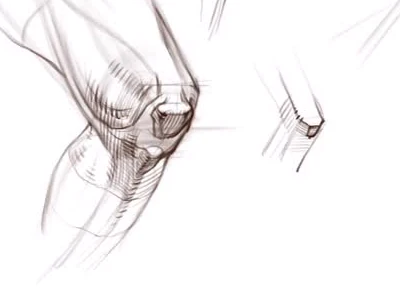
To check if I understand the shape, I draw the joint in an atypical position, for example, from above. The exits of the condyles of the femur and the tibial plateau are visible here. From below, I feel the fibula, the biceps tendon of the thigh stretches to it. One condyle is sharper, the other is softer because it is covered by a muscle. In the middle, I clarify the patella, the tendon goes down from it to the tuberosity, and all this can be traced by the midline: one, two, three for volume and four. It turns out to be a box, and it immediately becomes clear where the shape will go and how it will turn. Then I connect the cross-contour and slightly touch the edge of the bone.
Hatching according to the shape and simplification
I put the tone strictly according to the shape. Where the plane is frontal, the hatching goes in one direction, where it is lateral, in another, and these wraps immediately read the cube structure of the joint. Another rule that helps a lot: any complex shape can be simplified to a simple one. If I simplify the knee to a cube, ball, and cylinder, it's easier for me to perceive and draw it, and it's easier for the viewer to understand. Oddly enough, a simplified and collected joint looks more convincing than a carefully copied, but misunderstood mess of lines.
Common mistakes
- Drawing the knee as a flat circle. The patella is a volumetric triangular plate with planes, not a sticker. Show its volume.
- Putting the patella directly on the bone. The patella is stretched between the ligament below and the quadriceps tendon above. This affects how it moves on a straight leg and is compressed on a bent leg.
- Forgetting about the plateau and tuberosity. The cam of the femur rests on the tibial plateau, and the tuberosity is the support for the ligament. Without them, the joint falls apart.
- Drawing a straight and bent knee the same way. On the bent one, the patella comes out as the tip of the wedge, and the thigh breaks from the upper plane to the lateral one. These are different pictures.
- Hatching outside the shape. The hatching should follow the planes of the joint and show the wrap, otherwise the volume is not read.
Short advice
Don't copy the knee as it is. First, place the large shapes: the thigh, the lower leg, and the joint between them. Then assemble the framework from the femur, the plateau, and the patella, remember that the patella hangs on the ligaments, and only then fill in the muscles and put the tone according to the shape. Then the knee will connect the thigh with the lower leg and will no longer be the weak point of your leg drawing.