
ArticleUpdated: September 6, 2026
How to analyze references for artists
In short
Looking at other people's work is not enough — you have to take it apart. Anna Kholomkina uses one study to show seven layers of analysis, from composition and the spread of detail to reflections, subsurface scattering and brush choice. After that a reference stops being something to copy.

2D artist (illustrator)
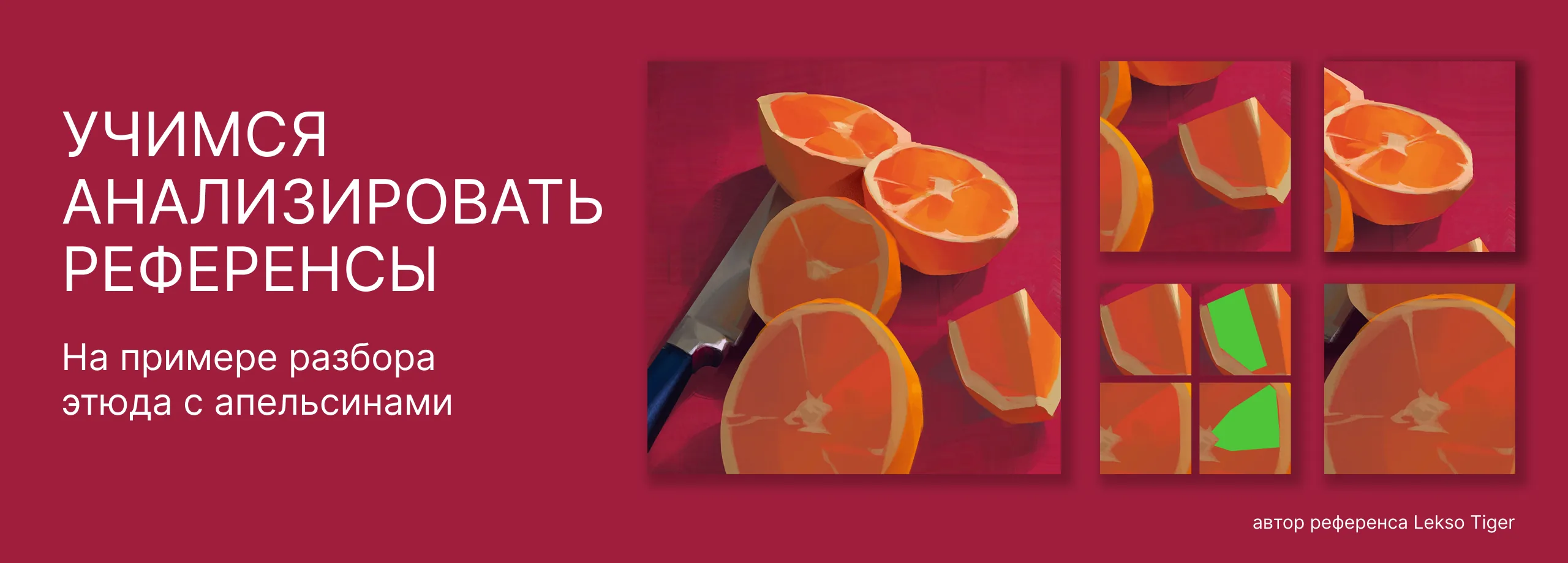 How to properly analyze references for drawing — read in the material by the curator of Skills Up School courses on 2D and Digital Painting Anna Holomkina.
Composition
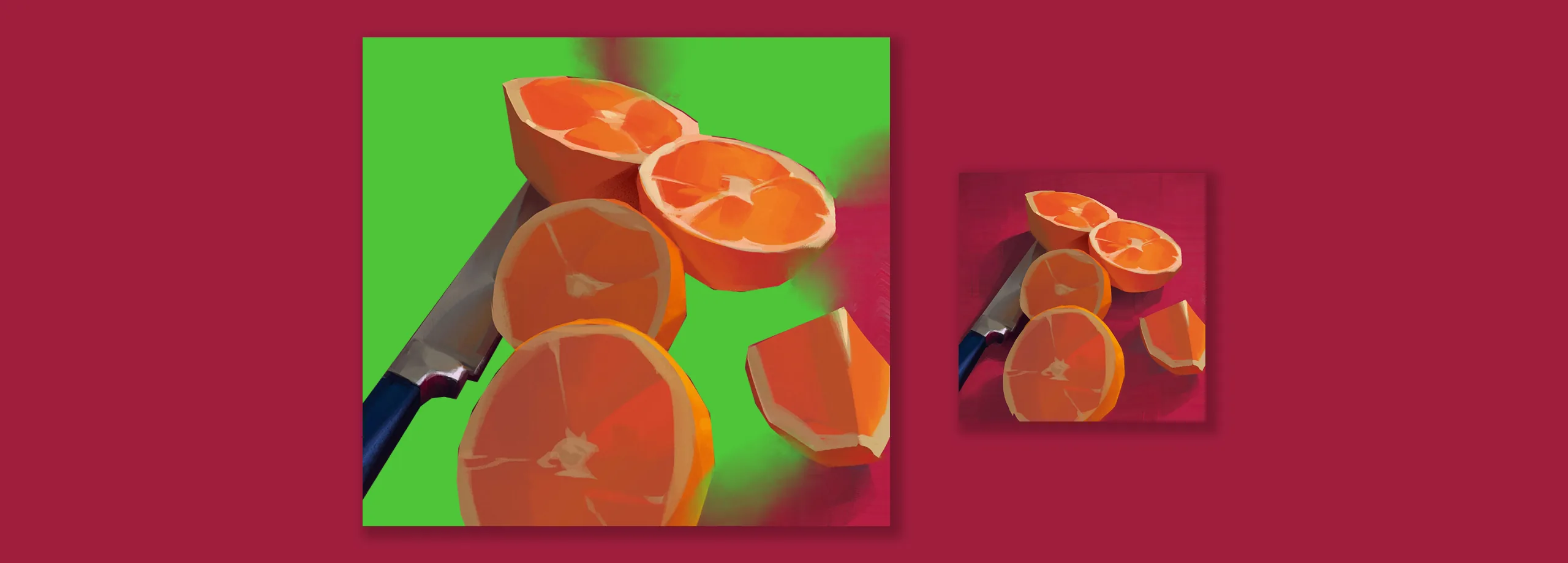
The composition is built on a triangle. We start with the knife — it is the most contrasting in tone and shade, the most noticeable. The blade points to the distant orange, from it we move to the orange in the foreground: the fruits closer to us become larger. Next, on the contrast of scale and shape, we notice a triangular piece on the right, and from it we return to the background again. Negative spaces — these are the spaces between objects, what we get if we mentally invert the silhouettes. They are also called counterforms — used wisely, they visually enrich the work.
Detailing
Related courses
All courses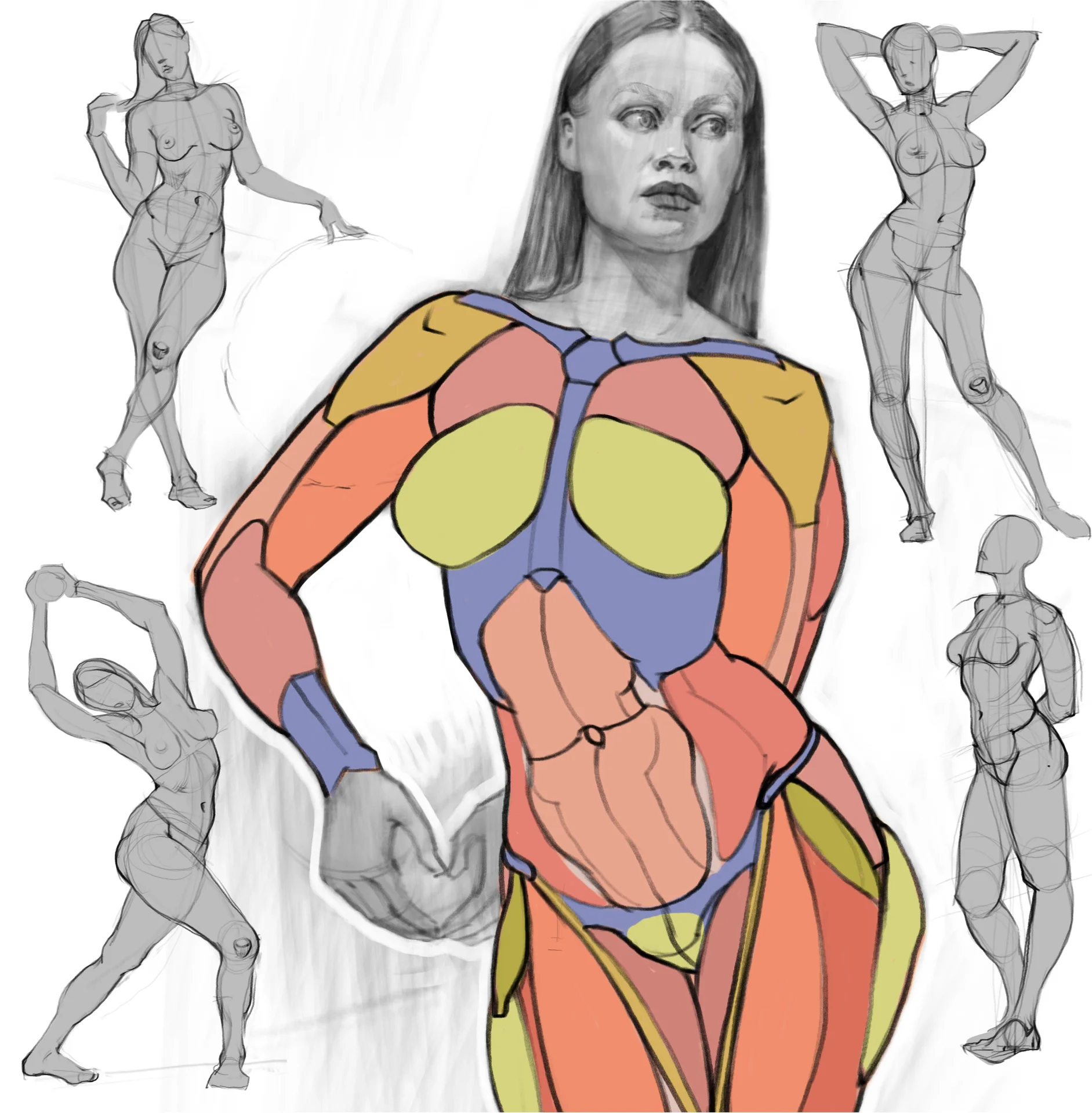
from 3 750 ₽
-25%
My first figure
5 000 ₽3 750 ₽
Learn more

from 4 950 ₽
-45%
Book illustration: The first page
9 000 ₽4 950 ₽
Learn more

from 4 950 ₽
-45%
Prop concept: render and atmosphere
9 000 ₽4 950 ₽
Learn more
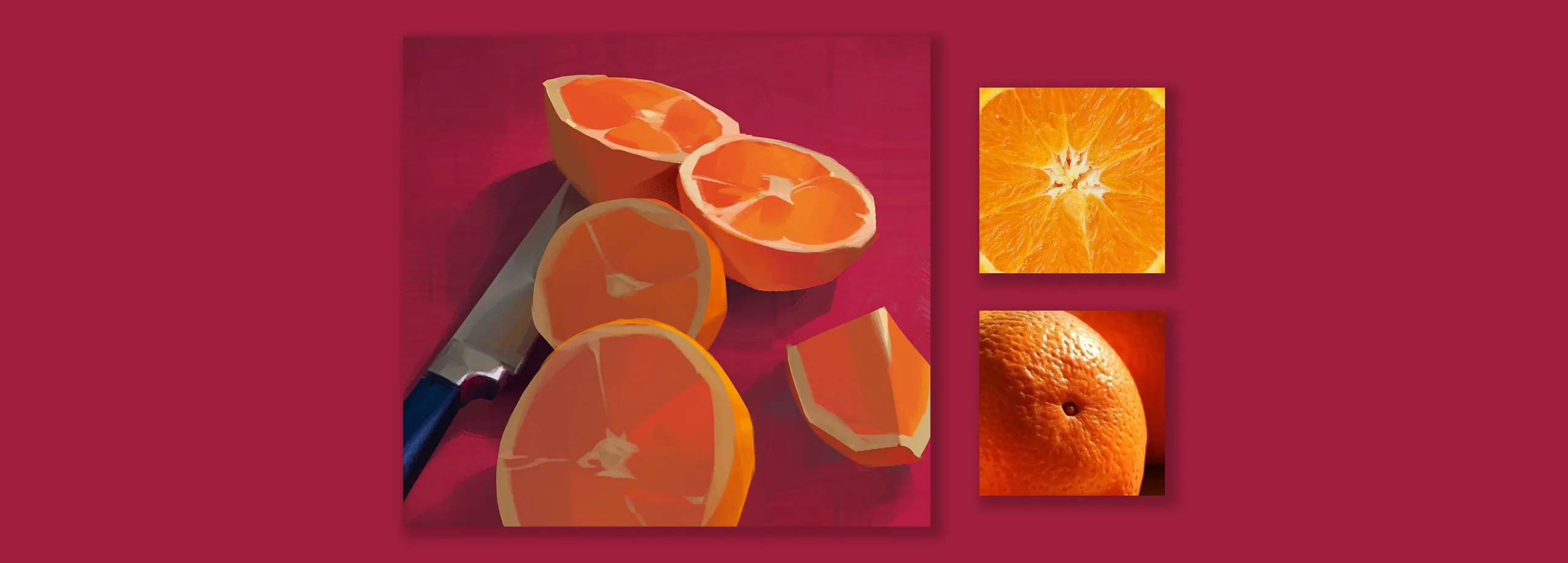
The detailing is minimal: there are no textures on the oranges, only the largest veins are left, the silhouettes are slightly chopped off, which is reasonable — this is a sketch, an exercise in tone, color, light, composition. It turns out that the picture does not automatically copy reality, but emphasizes and sharpens only its most notable features.
Warm and cold
We check the warm and cold: the light is warm, the shadow is cold. It is best to determine this by the illuminated and shadowed parts of the same material, otherwise it is easy to get confused.Not gray gray
It seems to us that the blade of the knife is gray, but it is not quite so. Gray itself is rarely used in painting, it is usually given at least a minimal shade.Reflexes
Reflexes appear on all objects, unite them and, as it were, help the neighboring colors to become friends. Without them, the depicted fruits, knife and background would look alien to each other.SSS
Organic objects have the SSS effect — subsurface scattering — this is subsurface light scattering. Light passes through a translucent body, but does not illuminate it, but as if gets stuck somewhere inside, and because of this we see a spot of greater saturation.Brush
And finally, let's look at the brush. To do this, you need to carefully study the work, paying attention to the completion of the smear and the edges of the objects — often in such places the shape of the brush is more obvious.Related materials

Article
References for the artist: arm references. Part 1
September 18, 2023
Tutorial
3D for 2D illustration: A comprehensive guide for artists
December 26, 2024
Article
The artist's dictionary: your guide in the world of creativity
March 18, 2025

Article
Digital painting. Skills of a modern artist
August 9, 2024
Article
Concept artist: overview of the profession
April 2, 2024
Tutorial
How to draw a crystal. Step-by-step guide for artists
March 24, 2025