
TutorialUpdated: September 6, 2026
Digital painting in Photoshop
In short
Marina Peregud paints a study of a bright flower in a glass vase and explains her decisions as she goes: which textured brushes she picks, how she sets up the canvas, how she carries the colour of the reference and the material of the glass.

Skills Up School
Online school of drawing and CG
Hello everyone! I'm — Marina Peregud, curator of courses in digital painting. In this tutorial, I will show you how to write a study of a bright flower. My task in this work was to convey the rich colors of the reference and the materiality of the glass vase — I paid special attention to these moments. Let's get started!
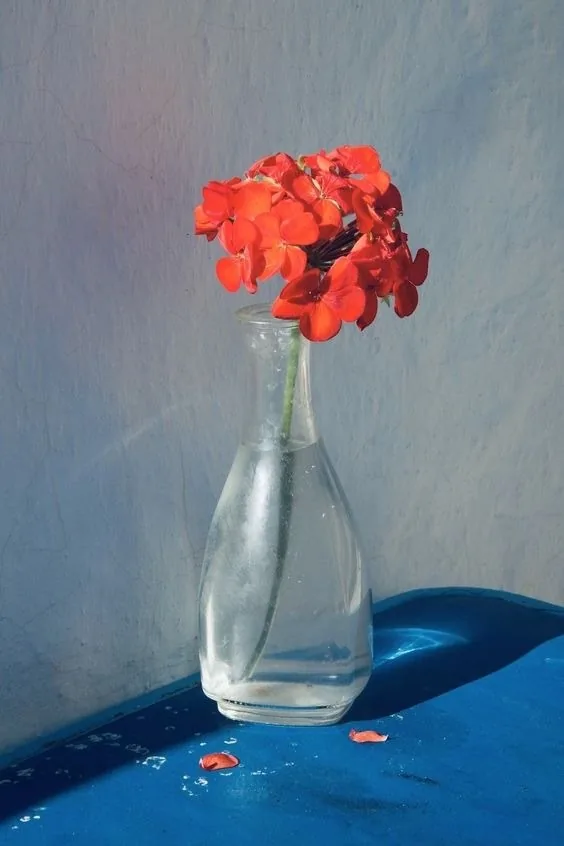 Reference
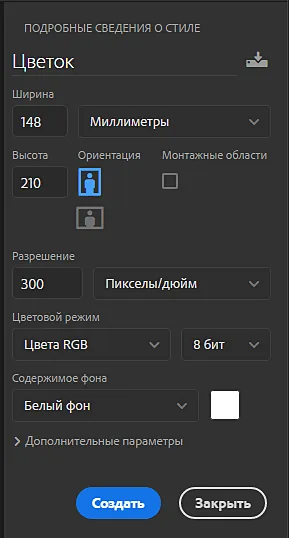 Creating a canvas
For the study, I use standard canvas parameters A5 format.
Creating a canvas
For the study, I use standard canvas parameters A5 format.
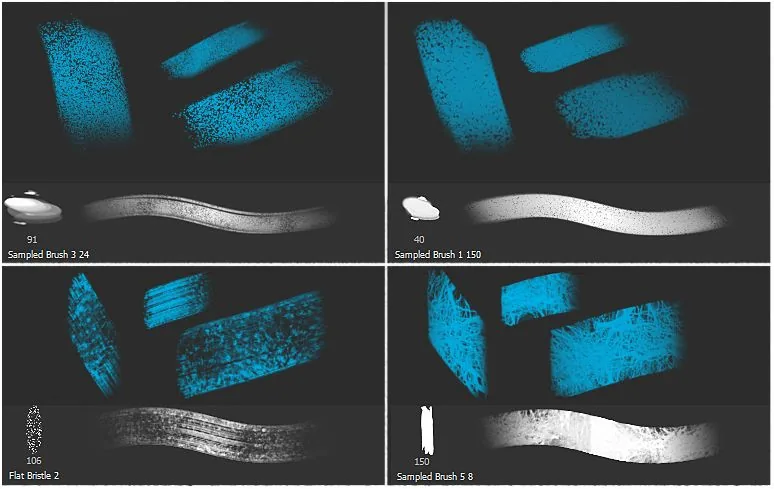 Brushes
We will work in the painting technique from the spot. You can learn more about digital painting in my article Digital painting for beginners. Let's start with the background. With large strokes of a texture brush we create the base of our image.
Then, with large and medium strokes, we outline the silhouette of the vase, as well as clarify the color of the background, add dark spots of shadows. In the initial stages, I try to work not too contrastingly.
Brushes
We will work in the painting technique from the spot. You can learn more about digital painting in my article Digital painting for beginners. Let's start with the background. With large strokes of a texture brush we create the base of our image.
Then, with large and medium strokes, we outline the silhouette of the vase, as well as clarify the color of the background, add dark spots of shadows. In the initial stages, I try to work not too contrastingly.
 Stage 1
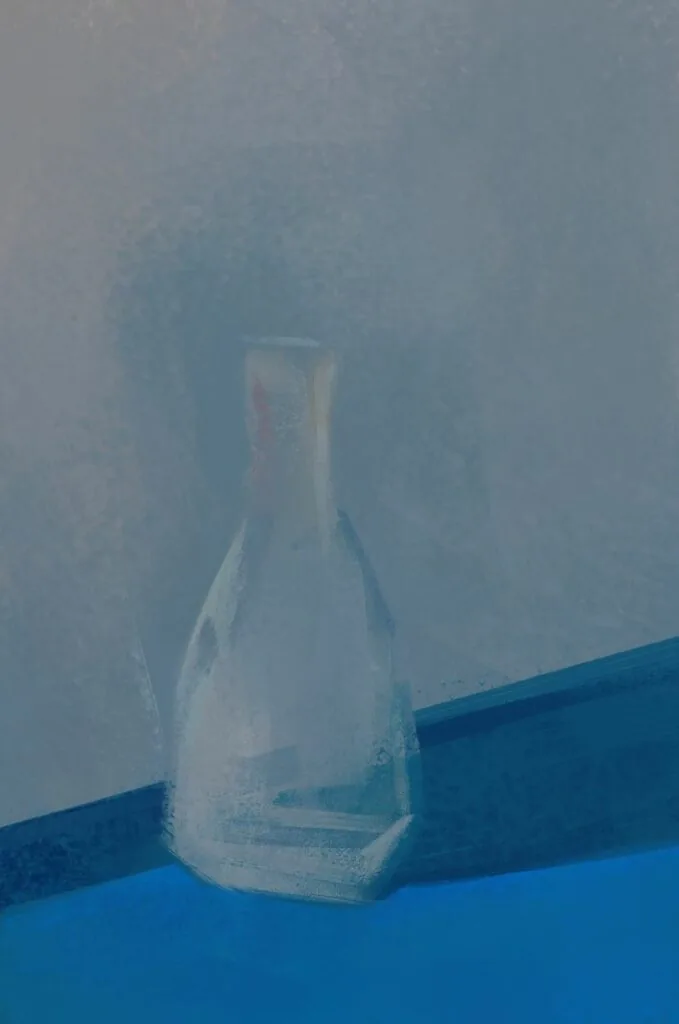 Stage 2
The next step adds a spot of flowers and a stem. To create soft edges, I use the «Finger» tool, blurring some of the spot boundaries with it. It is important not to get carried away with this tool so as not to make the drawing too «soapy». In the next steps, I plan to return the clarity to the flowers where needed.
Also, in parallel, we work on the vase a little, add reflections in the lower part and along the edges.
Stage 2
The next step adds a spot of flowers and a stem. To create soft edges, I use the «Finger» tool, blurring some of the spot boundaries with it. It is important not to get carried away with this tool so as not to make the drawing too «soapy». In the next steps, I plan to return the clarity to the flowers where needed.
Also, in parallel, we work on the vase a little, add reflections in the lower part and along the edges.
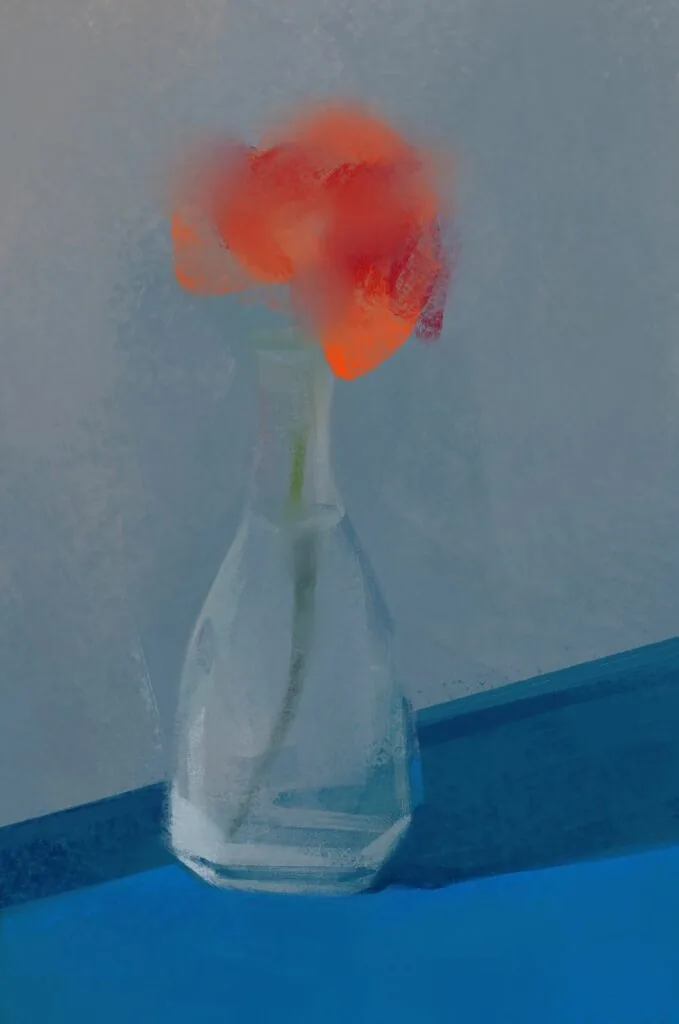 Stage 3
With a texture brush, we introduce several different shades of red into the flowers, highlight some petals and mark the lighting. Flowers in the light have a rich red hue — this is a warm color, on the palette we strive for red-orange. In the shade, red not only becomes darker, but also colder — on the palette we move towards crimson, red-violet color. Thus, the colors of the plant will remain clean and saturated.
It is important to note that we do not strive to draw the reference photographically accurately. We set ourselves the task based on the reference to create an expressive image in our own way, to conduct a kind of artistic selection, leaving only the most important thing. At the same time, each artist chooses the color scheme of the work, whether he needs to change or not change the composition of the sheet, interpret the shape and distances between objects. One thing is for sure: that the image of the study reflects the image of the reference and solves the tasks set by the artist.
Stage 3
With a texture brush, we introduce several different shades of red into the flowers, highlight some petals and mark the lighting. Flowers in the light have a rich red hue — this is a warm color, on the palette we strive for red-orange. In the shade, red not only becomes darker, but also colder — on the palette we move towards crimson, red-violet color. Thus, the colors of the plant will remain clean and saturated.
It is important to note that we do not strive to draw the reference photographically accurately. We set ourselves the task based on the reference to create an expressive image in our own way, to conduct a kind of artistic selection, leaving only the most important thing. At the same time, each artist chooses the color scheme of the work, whether he needs to change or not change the composition of the sheet, interpret the shape and distances between objects. One thing is for sure: that the image of the study reflects the image of the reference and solves the tasks set by the artist.
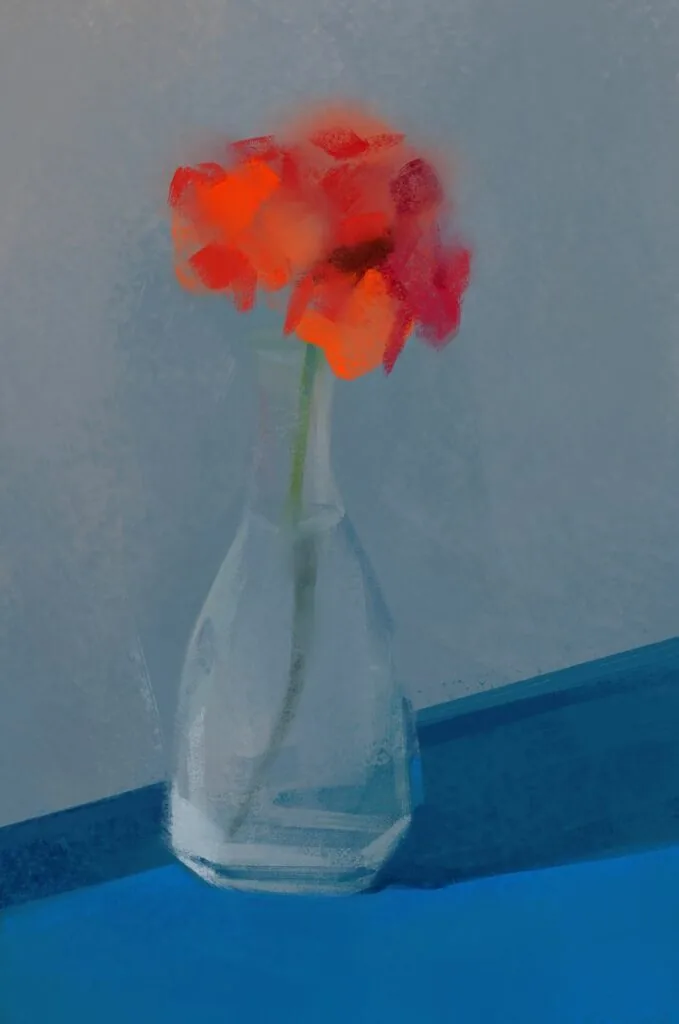 Stage 4
We return to the vase and start writing a soft highlight in the illuminated part. I really like the feeling that the vase is fogged up from cold water, and I will try to convey this effect. Let's look ahead a little and analyze the sequence of work on this detail.
Stage 4
We return to the vase and start writing a soft highlight in the illuminated part. I really like the feeling that the vase is fogged up from cold water, and I will try to convey this effect. Let's look ahead a little and analyze the sequence of work on this detail.
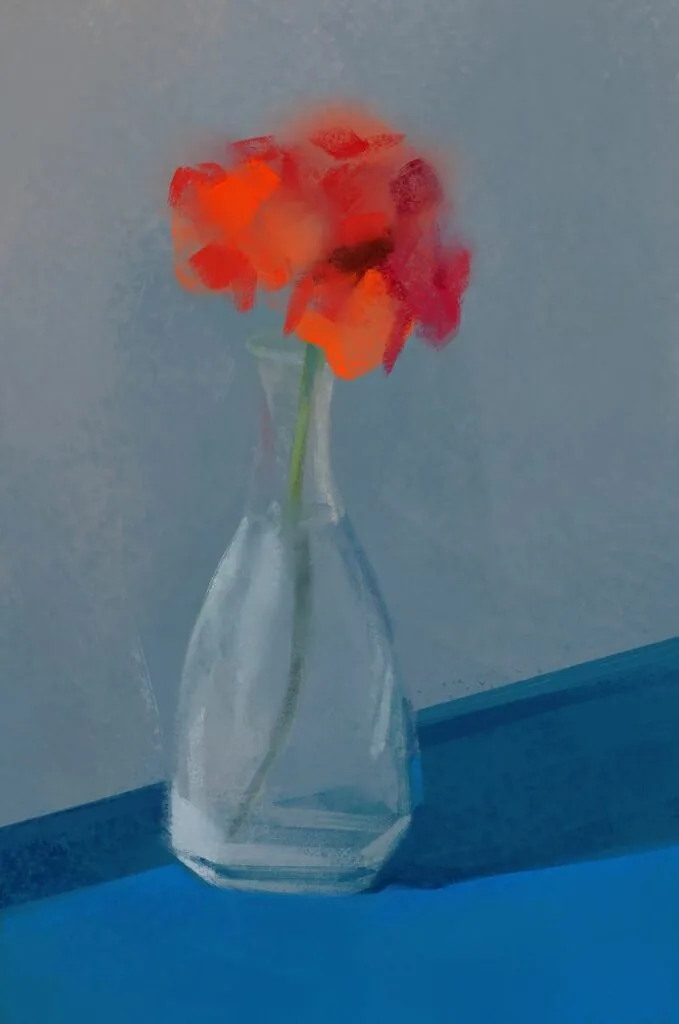 Stage 5
To begin with, we create a soft light spot in the illuminated part of the vase, using brush strokes and the «Finger» tool. Then, with a lighter color, we put several clear strokes, without blurring them.
Our task here — using the brush texture, create a soft interesting spot. The final touch is to put an even lighter spot of small size, enhancing the brightness and clarity of the highlight.
Stage 5
To begin with, we create a soft light spot in the illuminated part of the vase, using brush strokes and the «Finger» tool. Then, with a lighter color, we put several clear strokes, without blurring them.
Our task here — using the brush texture, create a soft interesting spot. The final touch is to put an even lighter spot of small size, enhancing the brightness and clarity of the highlight.
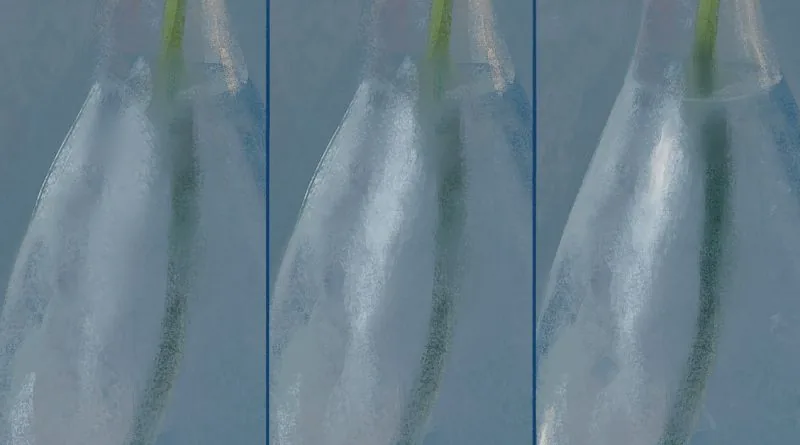 Sequence of work on the highlight
We continue to refine the vase, monitor the symmetry of the vase body and neck. Since the vase is at a slight angle to us, its bottom is not symmetrical: we correct the silhouette of the vase with a small brush, add smaller reflections, slightly blurring their boundaries with the «Finger» tool.
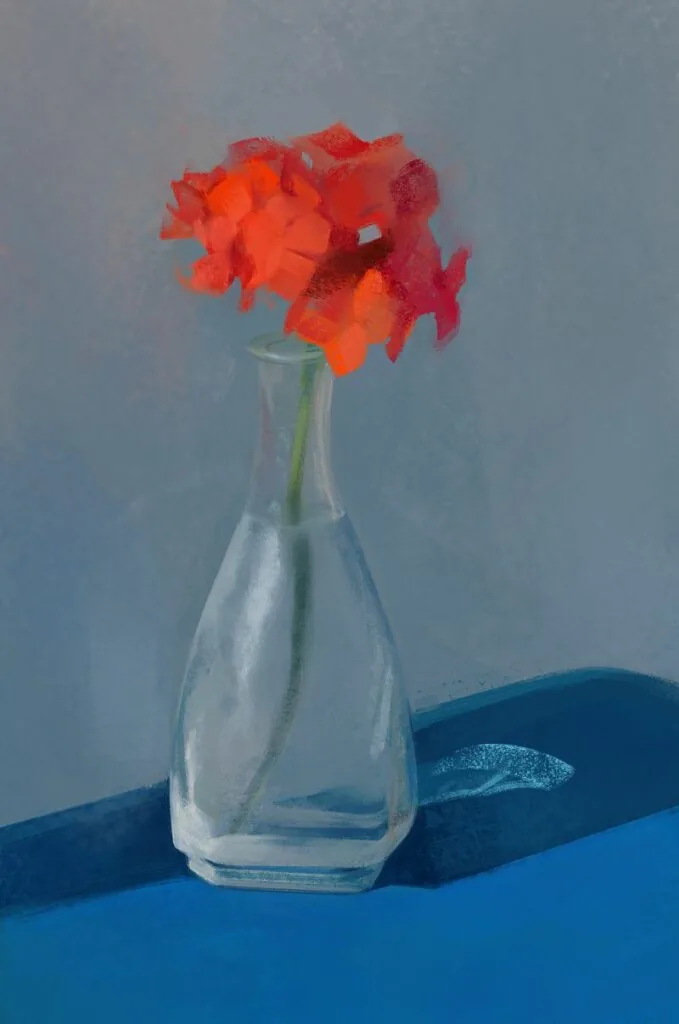
With soft strokes, we finalize the background. We add a very soft pinkish spot on the wall closer to the flowers to show the reflection from them. We correct the shape of the table, enhance the contrast of the падающей тени from the vase with dark strokes.
In the падающей тени we have an interesting light spot — caustic. Let's take a closer look.
Sequence of work on the highlight
We continue to refine the vase, monitor the symmetry of the vase body and neck. Since the vase is at a slight angle to us, its bottom is not symmetrical: we correct the silhouette of the vase with a small brush, add smaller reflections, slightly blurring their boundaries with the «Finger» tool.
With soft strokes, we finalize the background. We add a very soft pinkish spot on the wall closer to the flowers to show the reflection from them. We correct the shape of the table, enhance the contrast of the падающей тени from the vase with dark strokes.
In the падающей тени we have an interesting light spot — caustic. Let's take a closer look.
 Stage 6
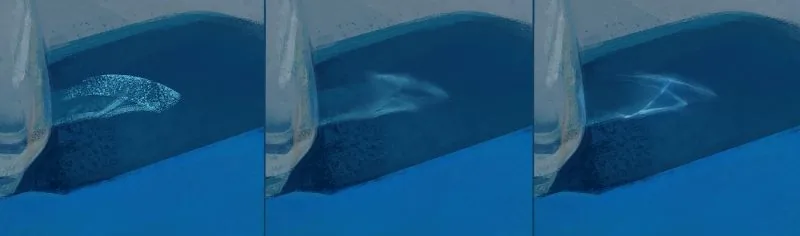
Caustics are called bright light curves of a bizarre shape that appear on a lit table on which a vessel with water is placed.
On a new layer, I create a bright spot, blur it with the «Finger» tool and erase the лишнего places with a soft eraser, creating the shape of our light spot. Then, with a small brush, I draw the lines of the caustic with bright shades, checking with the reference.
Stage 6
Caustics are called bright light curves of a bizarre shape that appear on a lit table on which a vessel with water is placed.
On a new layer, I create a bright spot, blur it with the «Finger» tool and erase the лишнего places with a soft eraser, creating the shape of our light spot. Then, with a small brush, I draw the lines of the caustic with bright shades, checking with the reference.
 Process of writing Caustic
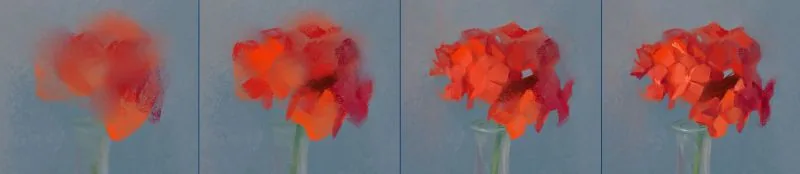
Our work is moving towards completion: it remains to work out the flowers and small details. Let's analyze the process of writing flowers a little more подробно.
We start work on the flowers with a soft spot of different shades of red. Then we introduce clearer strokes of a smaller size to set the approximate location of the petals.
We take the colors of the background and with a medium-sized stiff brush «cut out» the silhouettes of the flowers, getting rid of the overly soft shape. With small clear strokes, we add details and cold shadows from the petals to the neighboring flowers, draw light middles for some flowers.
In working on the flowers, I did not set the task to draw them perfectly accurately, but tried to catch their character. Competently combining soft and hard edges of strokes, you will achieve the most picturesque effect.
Process of writing Caustic
Our work is moving towards completion: it remains to work out the flowers and small details. Let's analyze the process of writing flowers a little more подробно.
We start work on the flowers with a soft spot of different shades of red. Then we introduce clearer strokes of a smaller size to set the approximate location of the petals.
We take the colors of the background and with a medium-sized stiff brush «cut out» the silhouettes of the flowers, getting rid of the overly soft shape. With small clear strokes, we add details and cold shadows from the petals to the neighboring flowers, draw light middles for some flowers.
In working on the flowers, I did not set the task to draw them perfectly accurately, but tried to catch their character. Competently combining soft and hard edges of strokes, you will achieve the most picturesque effect.
 Process of writing flowers
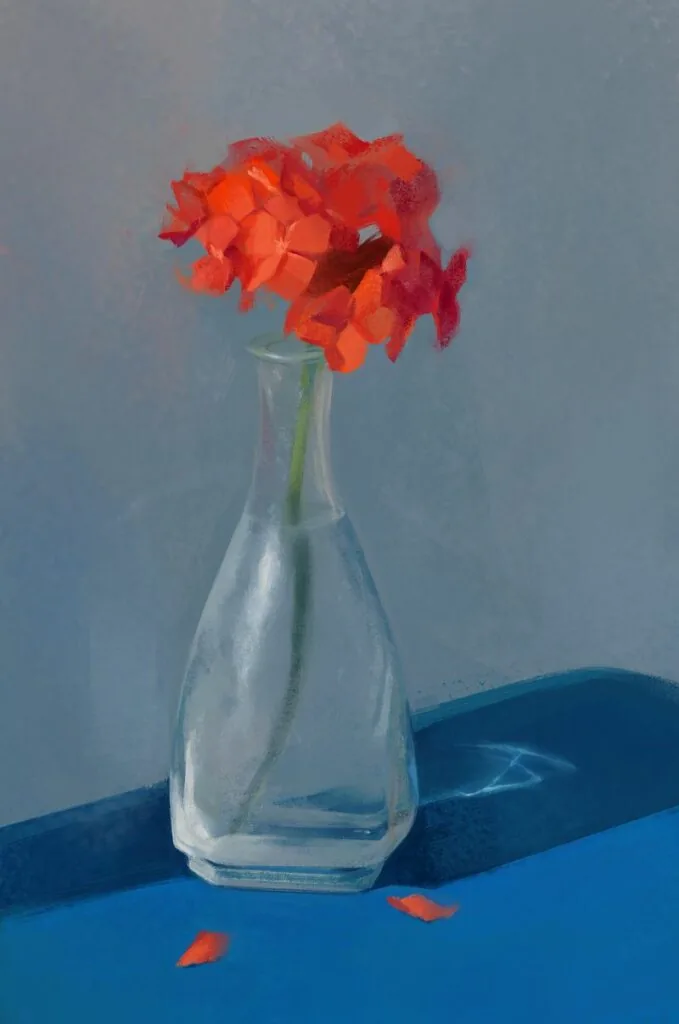
At the final stage, we work out small details. We add several light small spots to the vase — this will give it materiality and liveliness. Slightly enhance the brightness of the reflections in the lower part of the vase, add a couple of bright red petals to the table and draw thin падающие shadows from them.
Process of writing flowers
At the final stage, we work out small details. We add several light small spots to the vase — this will give it materiality and liveliness. Slightly enhance the brightness of the reflections in the lower part of the vase, add a couple of bright red petals to the table and draw thin падающие shadows from them.
 Final work
The work is completed!
Final work
The work is completed!
Reference
Creating a canvas
For the study, I use standard canvas parameters A5 format.
Choosing brushes
I love working with texture brushes! They make the work lively and allow you to achieve unusual effects. For this work, I used four brushes. Brushes 1 and 3 have a more active texture — I used them for the background and main spots. They reveal themselves to the maximum if you work with large and medium strokes. Brushes 2 and 4 have a less pronounced texture and are great for working out details, creating hard edges and placing accents. Recommend an useful article: brushes for photoshop
Brushes
We will work in the painting technique from the spot. You can learn more about digital painting in my article Digital painting for beginners. Let's start with the background. With large strokes of a texture brush we create the base of our image.
Then, with large and medium strokes, we outline the silhouette of the vase, as well as clarify the color of the background, add dark spots of shadows. In the initial stages, I try to work not too contrastingly.
Stage 1
Stage 2
The next step adds a spot of flowers and a stem. To create soft edges, I use the «Finger» tool, blurring some of the spot boundaries with it. It is important not to get carried away with this tool so as not to make the drawing too «soapy». In the next steps, I plan to return the clarity to the flowers where needed.
Also, in parallel, we work on the vase a little, add reflections in the lower part and along the edges.
Stage 3
With a texture brush, we introduce several different shades of red into the flowers, highlight some petals and mark the lighting. Flowers in the light have a rich red hue — this is a warm color, on the palette we strive for red-orange. In the shade, red not only becomes darker, but also colder — on the palette we move towards crimson, red-violet color. Thus, the colors of the plant will remain clean and saturated.
It is important to note that we do not strive to draw the reference photographically accurately. We set ourselves the task based on the reference to create an expressive image in our own way, to conduct a kind of artistic selection, leaving only the most important thing. At the same time, each artist chooses the color scheme of the work, whether he needs to change or not change the composition of the sheet, interpret the shape and distances between objects. One thing is for sure: that the image of the study reflects the image of the reference and solves the tasks set by the artist.
Stage 4
We return to the vase and start writing a soft highlight in the illuminated part. I really like the feeling that the vase is fogged up from cold water, and I will try to convey this effect. Let's look ahead a little and analyze the sequence of work on this detail.
Stage 5
To begin with, we create a soft light spot in the illuminated part of the vase, using brush strokes and the «Finger» tool. Then, with a lighter color, we put several clear strokes, without blurring them.
Our task here — using the brush texture, create a soft interesting spot. The final touch is to put an even lighter spot of small size, enhancing the brightness and clarity of the highlight.
Sequence of work on the highlight
We continue to refine the vase, monitor the symmetry of the vase body and neck. Since the vase is at a slight angle to us, its bottom is not symmetrical: we correct the silhouette of the vase with a small brush, add smaller reflections, slightly blurring their boundaries with the «Finger» tool.
With soft strokes, we finalize the background. We add a very soft pinkish spot on the wall closer to the flowers to show the reflection from them. We correct the shape of the table, enhance the contrast of the падающей тени from the vase with dark strokes.
In the падающей тени we have an interesting light spot — caustic. Let's take a closer look.
Stage 6
Caustics are called bright light curves of a bizarre shape that appear on a lit table on which a vessel with water is placed.
On a new layer, I create a bright spot, blur it with the «Finger» tool and erase the лишнего places with a soft eraser, creating the shape of our light spot. Then, with a small brush, I draw the lines of the caustic with bright shades, checking with the reference.
Process of writing Caustic
Our work is moving towards completion: it remains to work out the flowers and small details. Let's analyze the process of writing flowers a little more подробно.
We start work on the flowers with a soft spot of different shades of red. Then we introduce clearer strokes of a smaller size to set the approximate location of the petals.
We take the colors of the background and with a medium-sized stiff brush «cut out» the silhouettes of the flowers, getting rid of the overly soft shape. With small clear strokes, we add details and cold shadows from the petals to the neighboring flowers, draw light middles for some flowers.
In working on the flowers, I did not set the task to draw them perfectly accurately, but tried to catch their character. Competently combining soft and hard edges of strokes, you will achieve the most picturesque effect.
Process of writing flowers
At the final stage, we work out small details. We add several light small spots to the vase — this will give it materiality and liveliness. Slightly enhance the brightness of the reflections in the lower part of the vase, add a couple of bright red petals to the table and draw thin падающие shadows from them.
Final work
The work is completed!
Video lesson on digital painting
Painting — is a whole wonderful world full of the riot of color, pattern, tone and composition. Having got to know him, a person can better express himself, his feelings and the beauty of the world around him. Come to us for digital painting courses: we will explore this most interesting form of modern art together! May the force be with you 🙂Want to try digital painting in practice? See the step-by-step guide on how to draw a still life step by step, from composition to tone.
Related materials
Tutorial
Color in digital painting
February 13, 2025
Article
Useful hotkeys in Photoshop
September 18, 2023
Tutorial
Digital painting for beginners
July 3, 2024

Tutorial
How to draw in Adobe Photoshop?
March 15, 2024
Tutorial
How to draw a mushroom in Photoshop
March 6, 2024

Article
Digital painting. Skills of a modern artist
August 9, 2024