
TutorialUpdated: September 6, 2026
How to draw basic emotions
In short
There are six basic emotions — joy, sadness, anger, surprise, fear, disgust. For each one you see what happens to the brows, the eyes and the mouth. Why a character in a book, a game or an animation needs emotion, and how to draw them without sliding into identical grimaces.

2D artist
The word "emotion" is translated from Latin as "to shake, to волновать". And it's really amazing: we can be overwhelmed by a wave of anger, captured by a hurricane of joy, excited by excitement every cell of the body and feverish with fear! Did you know that emotions are not only our feelings, but also our broadcast of feelings to the world around us? Thanks to this, we understand the state of the interlocutor and demonstrate our own. We are so used to emotions that we do not think about how to show them or read them in a neighbor. But how to convey them on paper or a digital canvas, what lines and colors to use? Today we will analyze how to draw basic emotions so that your works literally "speak" with the viewer.
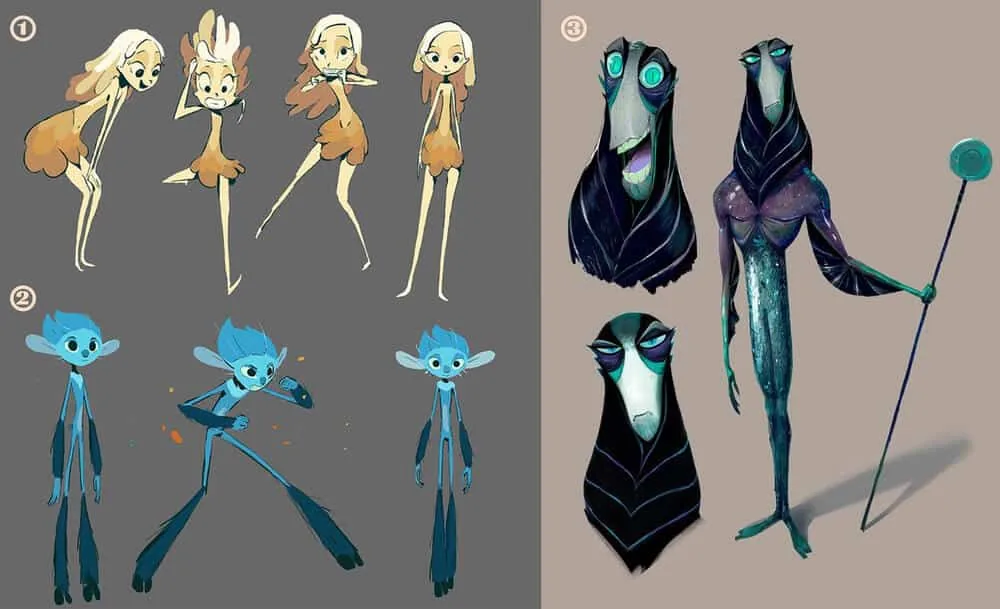 The characters of the cartoon "Moonlighter" from Studio La Cachette have different types, and accordingly, establish an emotional connection with the viewer or, conversely, break it forever.
1 - Waxy girl Glim, kind and light, dreaming of traveling. Even in moments of her dissatisfaction or fear, she remains charming and attractive.
2 - A young forest faun, the main character who loves to play and have fun. Sometimes he is insecure or upset, but like Glim does not lose charm and good essence.
3 - Well, Lyon is a secondary antagonist, eternally dissatisfied, plotting and striving for power. He always expresses negative emotions, even when he is happy.
The characters of the cartoon "Moonlighter" from Studio La Cachette have different types, and accordingly, establish an emotional connection with the viewer or, conversely, break it forever.
1 - Waxy girl Glim, kind and light, dreaming of traveling. Even in moments of her dissatisfaction or fear, she remains charming and attractive.
2 - A young forest faun, the main character who loves to play and have fun. Sometimes he is insecure or upset, but like Glim does not lose charm and good essence.
3 - Well, Lyon is a secondary antagonist, eternally dissatisfied, plotting and striving for power. He always expresses negative emotions, even when he is happy.
Why learn to draw emotions?
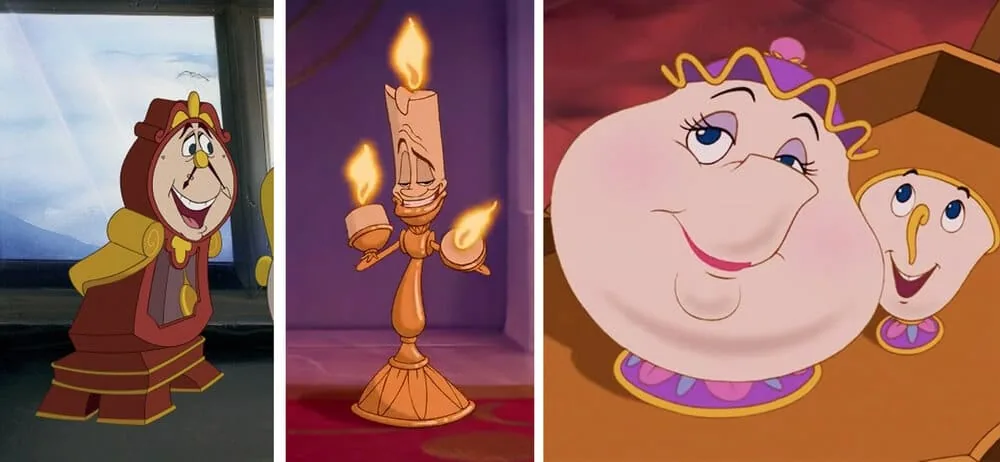
If your goal is to learn to draw landscapes or still lifes, then images of human emotions will not be needed to you. It is unlikely that your kettle will flirt with mugs and fawn over spoons. But in a cartoon there can be animated dishes, and a coffee pot can smile. It is at this moment that you will need the magic that turns an inanimate and static character into a bright hero. Disney studio used this magic to bring to life the utensils, cutlery and furniture in the cartoon "Beauty and the Beast".
The function of emotions for characters in books, games, animation and cinema:
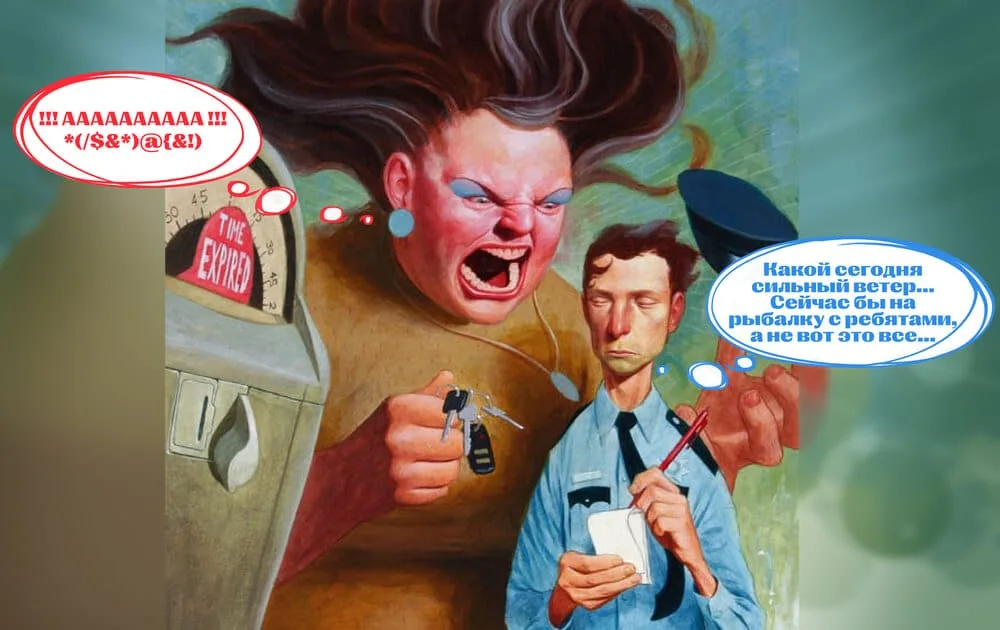
- Convey the mood of the characters and scenes. Thanks to facial expression and body language, the viewer will feel the character's character, get the right impression of the environment. Usually the surrounding landscape echoes the heroes and tries with all its might to brighten up the triumph of the moment or the gloom of the events taking place. Look at the work of illustrator Jeremy Enecio: there is a confrontation between a woman and a man. She обрушивает her rage on the inspector, but he has put up a wall of calm in front of her.
- Create a connection with the viewer. People love works that evoke a response. You show emotions, people react to them, you attract someone and repel someone else. The same happens to you, you reach out to someone and strive to avoid someone else. The task of the drawn characters is the same function: to evoke empathy or rejection. The character must create a response, not be an apathetic dummy.
The characters of the cartoon "Moonlighter" from Studio La Cachette have different types, and accordingly, establish an emotional connection with the viewer or, conversely, break it forever.
1 - Waxy girl Glim, kind and light, dreaming of traveling. Even in moments of her dissatisfaction or fear, she remains charming and attractive.
2 - A young forest faun, the main character who loves to play and have fun. Sometimes he is insecure or upset, but like Glim does not lose charm and good essence.
3 - Well, Lyon is a secondary antagonist, eternally dissatisfied, plotting and striving for power. He always expresses negative emotions, even when he is happy.
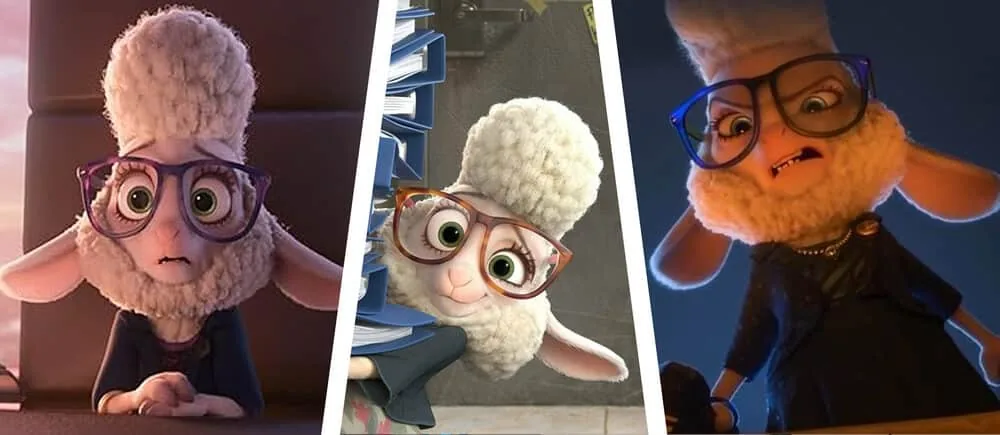
- Reveal the character's character. A certain set of emotions creates one image of a hero, but what if he can not only be happy and friendly? His emotions of anger, despair, envy or annoyance will show him from a completely different side. Maybe he is not such a goodie as he wants to seem. In the cartoon Zootopia, the white sheep Miss Barashkins, who seemed shy and fussy charming, turned out to be the main villain who caused dangerous disorders and social раскол between the animals.
Basic emotions and how to draw them
The spectrum of emotions is incredibly wide, it is like a colorful palette with hundreds of shades, all the time flowing into each other. Sometimes it seems to us that the human face is like mother-of-pearl - it also shimmers all the time and reflects the environment through the prism of its essence. There are understandable and clear emotions, and there are ambiguous or contradictory ones. The latter are born on the basis of simple basic ones. On the face they are manifested with the help of facial muscles, which force the facial features to transform. Let's look at the anatomical features when such emotions appear:Joy
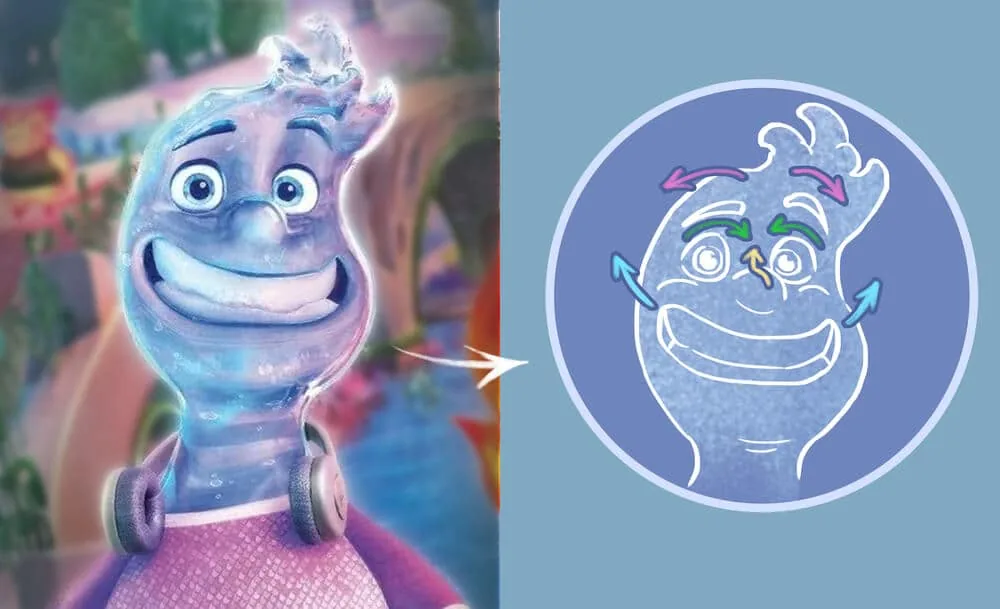
In moments of jubilation, the face brightens, acquires a shade of openness to the world and happiness. Naturally, the face smiles, the mouth stretches, the corners of the mouth rise up, the cheeks round, and the eyes can be wide open or slightly narrowed. Brows arch, pull up, but remain unstrained. Well, the tip of the nose can be a little upturned, following the eyebrows. The higher the level of delight, the wider the eyes and smile. You will not believe it, but the ears also participate in this process and rise slightly up, just a little. Look at the water boy Wade from "Elementary". He radiates cheerfulness.
Sadness
Related courses
All courses
from 4 250 ₽
-75%
Game interface design
17 000 ₽4 250 ₽
Learn more

from 14 973 ₽
-77%
2D graphics Basic
65 100 ₽14 973 ₽
Learn more
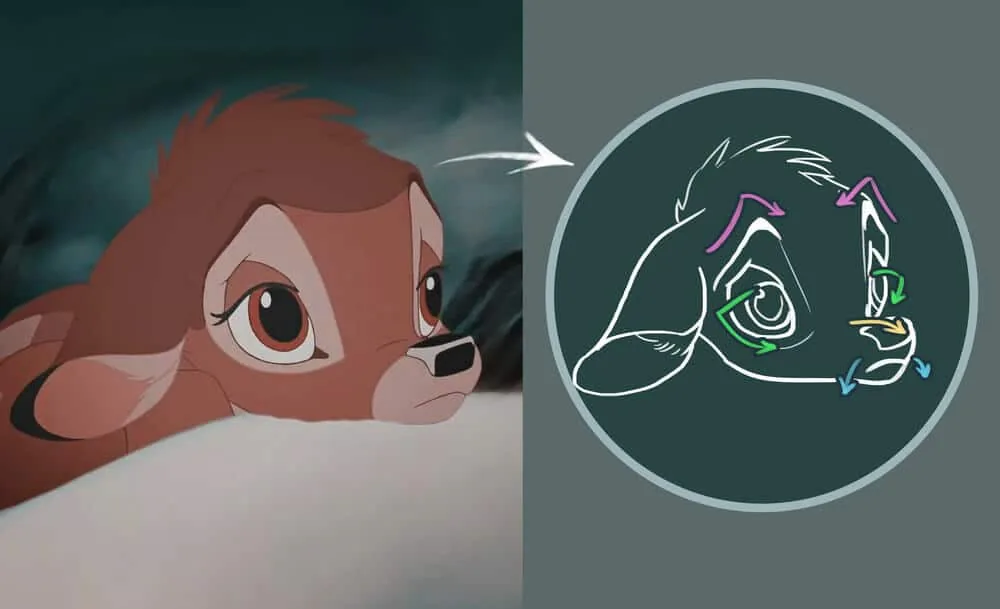
Let's consider it on the example of the sad fawn Bambi. Sadness can be ярко выраженной or more calm and melancholic: the mouth bends with the corners down a little. The upper eyelids cover the eyes, the brows bend with joyless corners upwards. Why is the third eyelid often hangs over the eye, cutting off its corner, as in our hero. The nose remains straight or slightly stretches down to the lip line. Animals' ears droop and hang limply. Imagine a blob fish, sadness looks exactly like that, as if the face is trying to slide to the very bottom of the ocean.
We recommend an interesting article: how to draw a human nose
 Warm colors are always associated with positive, cold with negative. The darker their shade, the more gloom and ominousness you will get. And the lighter, the more light, goodness and clarity will be laid in the subject. More details about the semantics of color you can read in our article Basics of color theory.
 Let's create a new layer and mark the shadow edges of our cat's head with light gray. Our task is just to divide the shape into shadow and light, we are not aiming for a complex volumetric modeling (3). Well, now on the layer under the line and shadow, we will add a new layer and paint our cat with monophonic fills (4). Why do we need this? Of course, we can do without this step. However, spots on the ear and around the eye, colored cheeks and eyebrows will help us more clearly trace the transformation of the muzzle.
 Let's move on to a new emotion, now our kitty will see something unexpected. Let's give her face an emotion of surprise mixed with fear. To do this, we will turn off the opacity of the previous stage of the muzzle and start raising the surprised eyebrows up, opening the eyes wide, opening the jaw and lowering the ears (5). First we do it with light draft lines. And then we press harder on the stylus and make a clean line. We have also added straight lines and semicircles on the surface of the head, simulating ruffled fur. This adds credibility to our emotion. Since our heroine's mouth is приоткрываясь, we will need to draw teeth and a tongue (6).
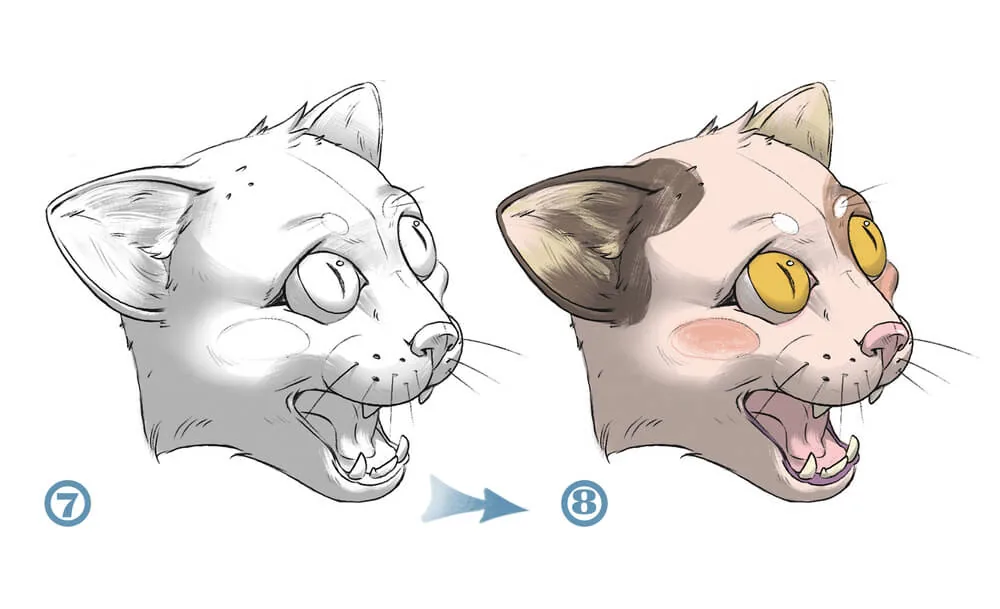
 We will do the same actions to fill the head with shadows (7). Keep an eye on the new shape, do not leave the shadows in the same place. And then we will paint the cat in the same color. Since the ears have dropped lower, the cheeks have risen and narrowed, the eyes have widened, then following the transformations of the head we change the shape and location of our color spots (8).
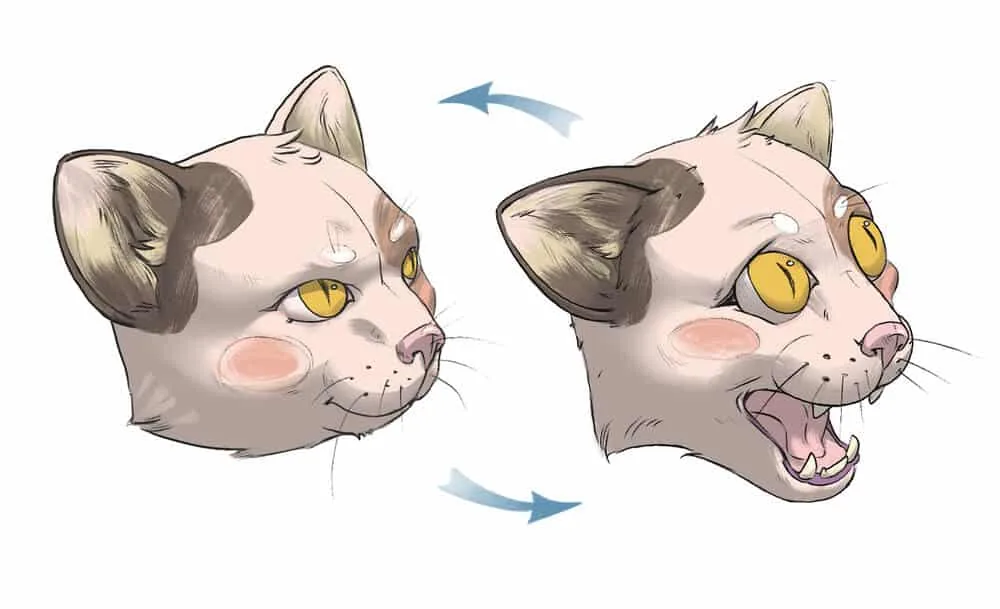
 Here are 2 emotions ready! Compare both stages, the left one is softer and smoother in lines, it is satisfied. And in the right one, even the whiskers have tensed, they stretched out in a line and resemble ringing strings. Try to create the same character and experiment with him, give his face not only surprise, but also joy, sadness or rage.
 That's it, at the most interesting point we have come to the end of our article with you. But how much we have managed to study and analyze with you! We hope that it was useful to you, and we were able to inspire you to draw. Never give up what you have started and may motivation be with you!
Anger
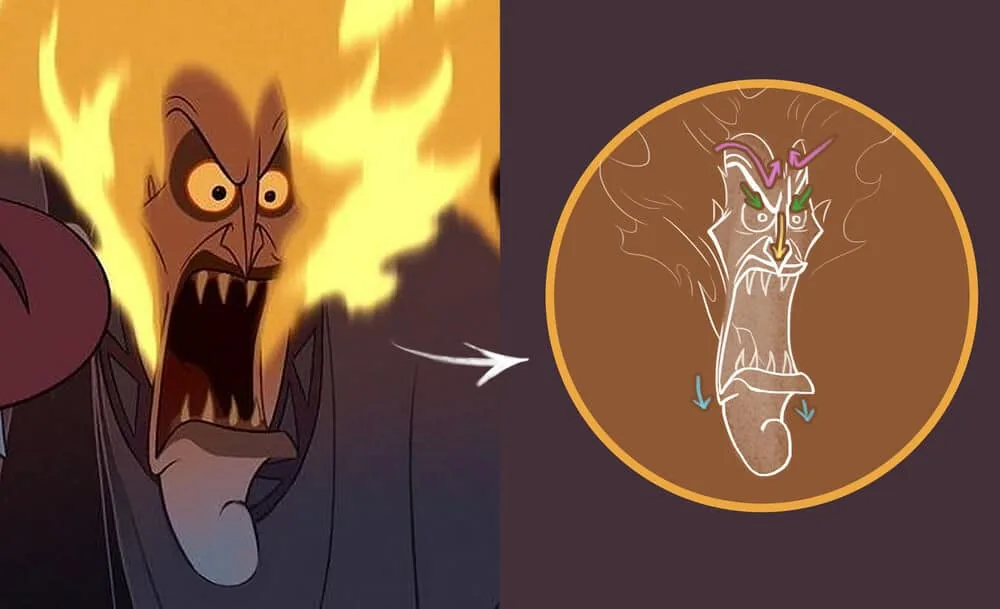
Do you remember Hades from the cartoon about Hercules? That's an explosive type, his face is beautifully crafted by animation artists. It is very convenient to study the key nuances of aggression on it. The mouth opens and shows a bestial grin, the nose sharpens and wrinkles, the nasolabial fold gathers with sharp wrinkles around the mouth. Brows with curly lines shift to the bridge of the nose, blocking the top of the eyes. Perhaps the eyes will be wide open, or they will be squinting. We recommend an interesting article: how to draw a human face
Surprise
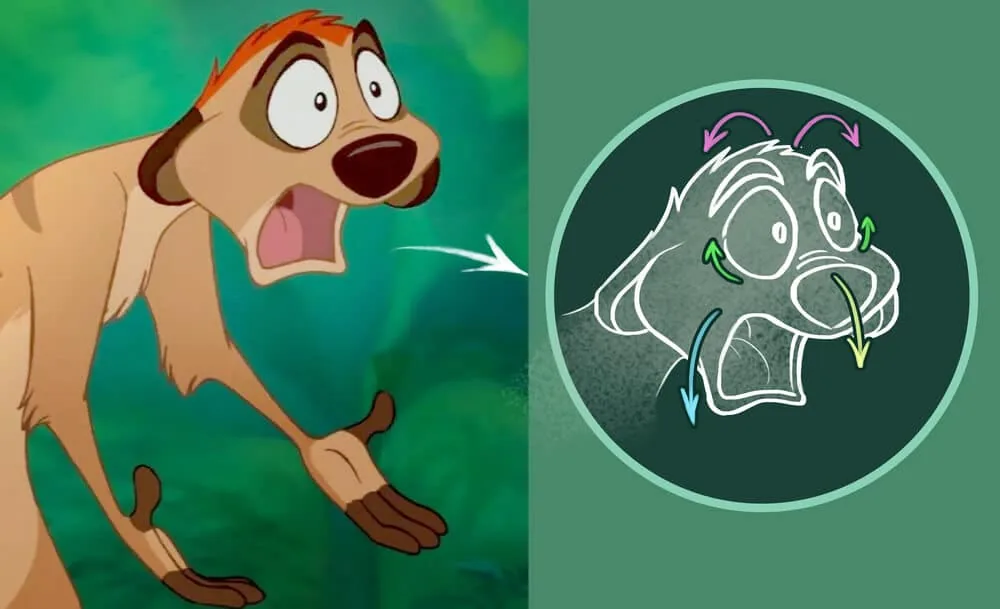
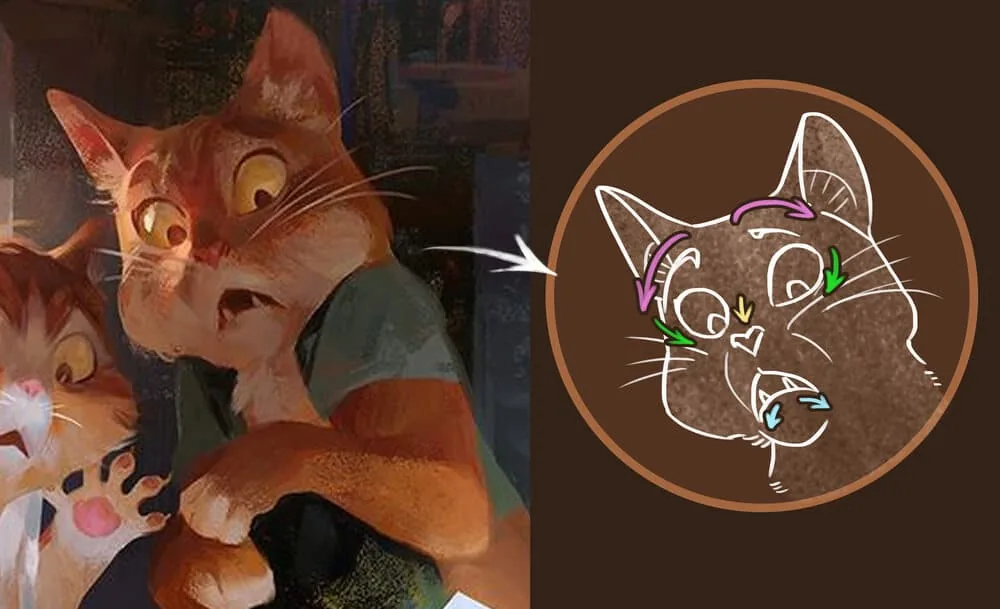
We can say that this is a vivid impression of something unexpected. It can have an admixture of joy if the events are positive, or sadness in a negative situation. And sometimes, in danger and irritation, it develops into fear. Feelings are so strong that they knock the emotional state out of balance. The meerkat from the cartoon "The Lion King" Timon "jaw dropped", the whole lower part of the face stretches down, as if a heavy load was attached to it. Eyes are rounded, but no longer have a squint, as in moments of joy. Brows are arched with tense arcs, sometimes bending with corners.
Fear
It is not for nothing that they say that fear has big eyes. This is an emotion in which a person also experiences surprise from the unexpected, turning into fear. Eyes are wide open, pupils often narrow and concentrate on the object of fear. Brows crawl far away on the forehead with tense arcs, the nose опускается slightly down, and the corners of the mouth with offended angles stretch even lower than the nose. In addition, the ears and fur of animals, or our rare hairs, begin to bristle. In animals, the whiskers and hair on the withers are especially noticeable.
Disgust
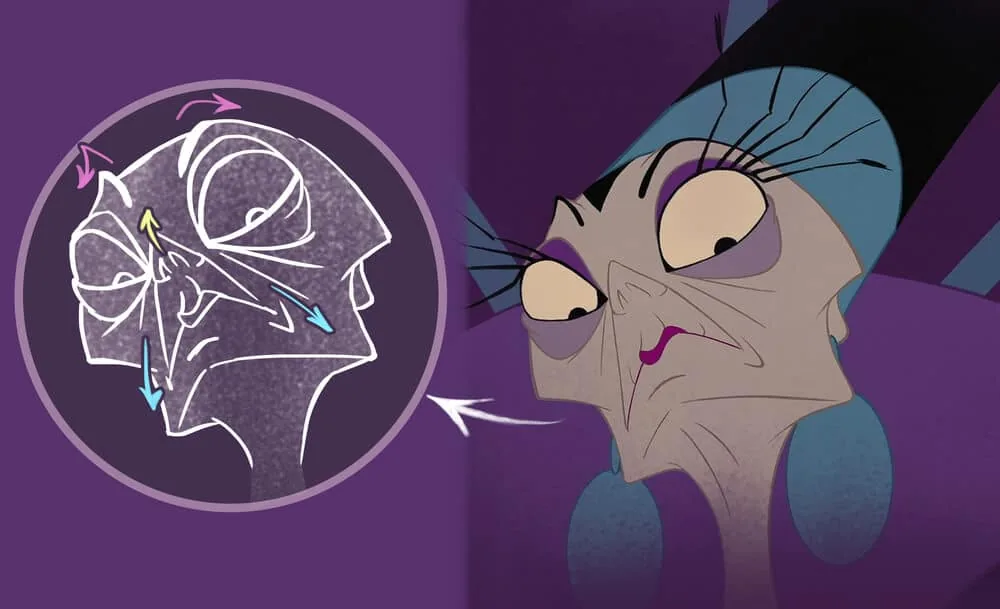
The feeling of hostility is partially born from anger, but does not grow into a raging fire, but rather resembles a smoldering bonfire with very acrid smoke. This dissatisfaction is manifested by a wrinkled and raised nose (as if from an unpalatable smell), squinted eyes, brows сдвинутыми to the переносице. Sometimes the brows do разнонаправленные actions: one frowns, the second bends in a wave. Lips turn into a thread. For example, like the incomparable Izma from the cartoon about the Emperor-lama. Sometimes the upper lip rises, showing a grin. And the corners of the lips with sharp wedges look down. We recommend an interesting article: how to draw lips
The technique of drawing emotions
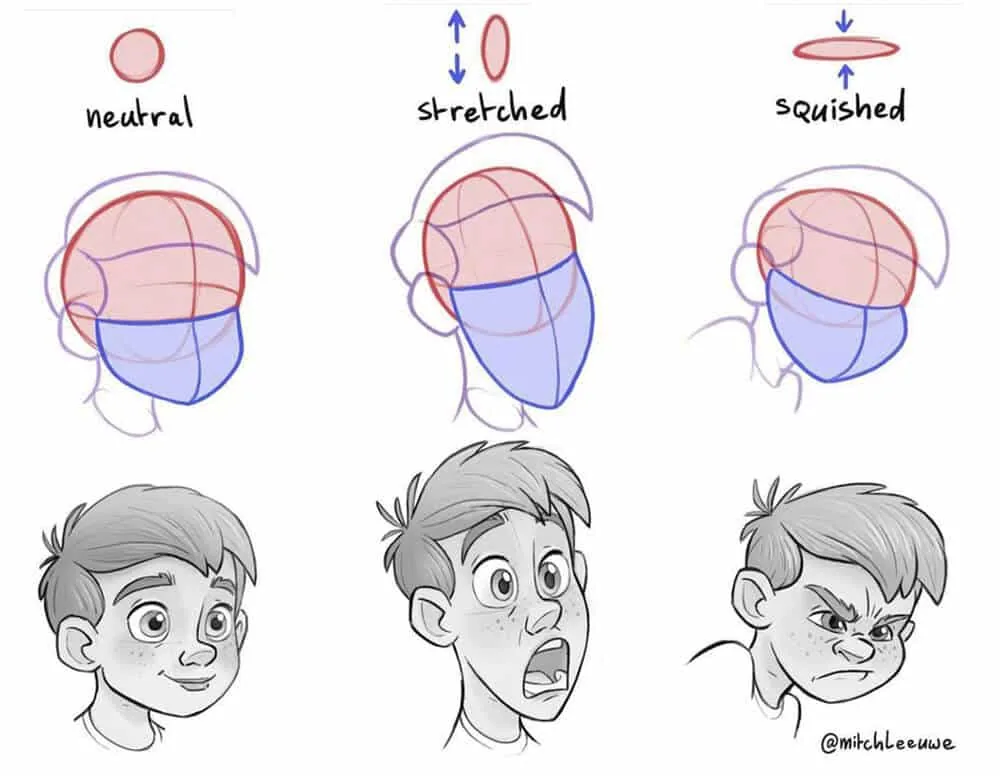
If you are still not very interested, then we have come to the most fascinating moment! Drum roll, horn and ... timpani! We will talk about nuances and life hacks on the example of human characters.- Emotions deform the head
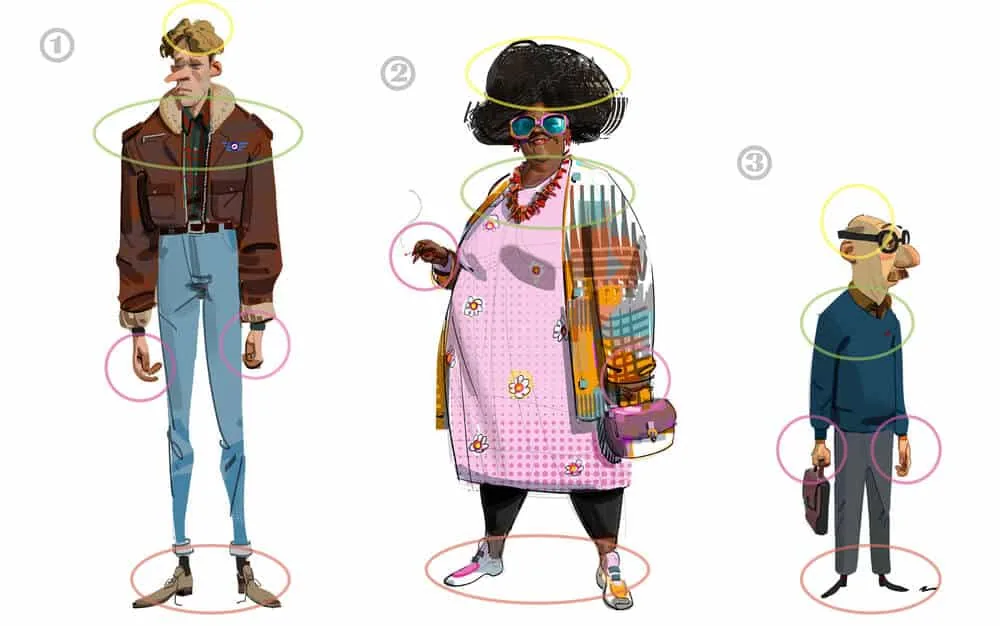
- Emotions are not only the face
- Emotions show color
Warm colors are always associated with positive, cold with negative. The darker their shade, the more gloom and ominousness you will get. And the lighter, the more light, goodness and clarity will be laid in the subject. More details about the semantics of color you can read in our article Basics of color theory.
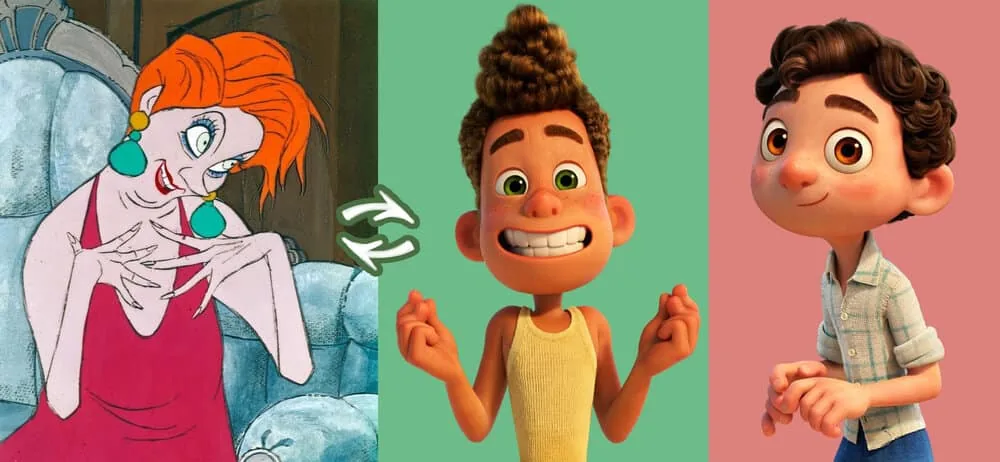
- Based on simple forms
Lesson on drawing emotions
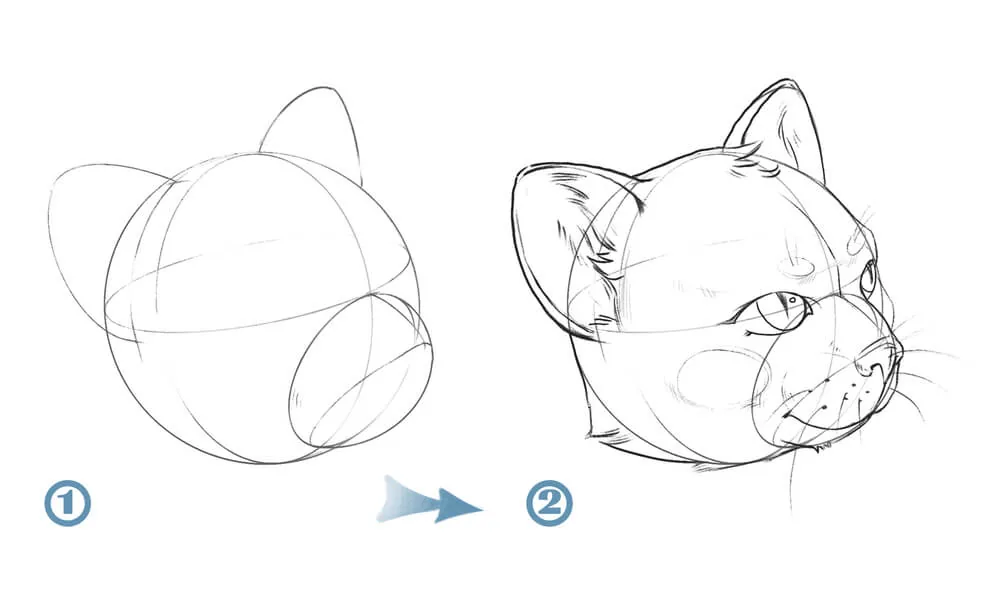
We will try to convey 2 emotions to the animal with you. It is easier to explore this topic with them than with people. Why not draw a cat's face, that's a really great idea. Let's go step by step and first draw a simple head dummy (1). On the marked form of the sphere, the corners of the ears and the hemisphere of the nose, we draw the parts of the face on a new layer. We place the cunning eyes on the horizontal axis prepared in advance. We mark the ovals of the eyebrows, the nose, a slightly smiling mouth, the ovals of the cheeks, the whiskers and we detail the ears with fur (2).
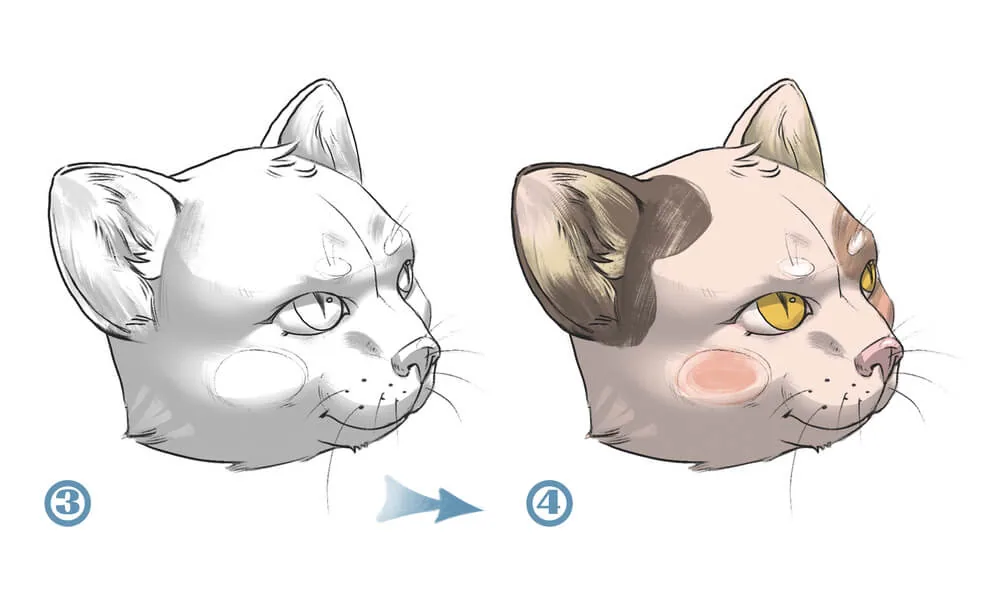
Let's create a new layer and mark the shadow edges of our cat's head with light gray. Our task is just to divide the shape into shadow and light, we are not aiming for a complex volumetric modeling (3). Well, now on the layer under the line and shadow, we will add a new layer and paint our cat with monophonic fills (4). Why do we need this? Of course, we can do without this step. However, spots on the ear and around the eye, colored cheeks and eyebrows will help us more clearly trace the transformation of the muzzle.
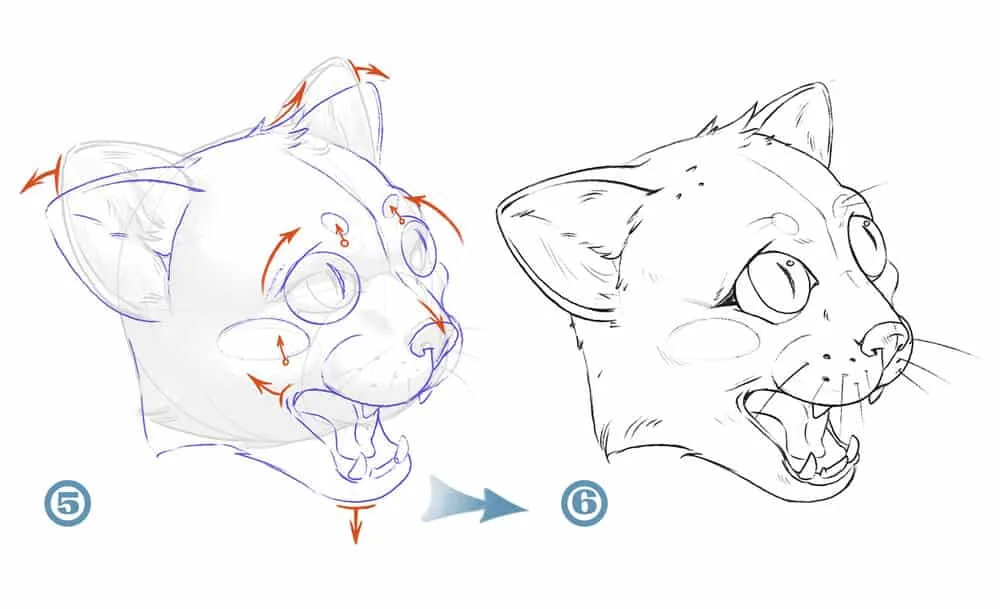
Let's move on to a new emotion, now our kitty will see something unexpected. Let's give her face an emotion of surprise mixed with fear. To do this, we will turn off the opacity of the previous stage of the muzzle and start raising the surprised eyebrows up, opening the eyes wide, opening the jaw and lowering the ears (5). First we do it with light draft lines. And then we press harder on the stylus and make a clean line. We have also added straight lines and semicircles on the surface of the head, simulating ruffled fur. This adds credibility to our emotion. Since our heroine's mouth is приоткрываясь, we will need to draw teeth and a tongue (6).
We will do the same actions to fill the head with shadows (7). Keep an eye on the new shape, do not leave the shadows in the same place. And then we will paint the cat in the same color. Since the ears have dropped lower, the cheeks have risen and narrowed, the eyes have widened, then following the transformations of the head we change the shape and location of our color spots (8).
Here are 2 emotions ready! Compare both stages, the left one is softer and smoother in lines, it is satisfied. And in the right one, even the whiskers have tensed, they stretched out in a line and resemble ringing strings. Try to create the same character and experiment with him, give his face not only surprise, but also joy, sadness or rage.
That's it, at the most interesting point we have come to the end of our article with you. But how much we have managed to study and analyze with you! We hope that it was useful to you, and we were able to inspire you to draw. Never give up what you have started and may motivation be with you!Related materials
Tutorial
How to draw hair with a pencil
July 30, 2026
Tutorial
How to draw lips
August 15, 2024
Tutorial
How to draw a crystal. Step-by-step guide for artists
March 24, 2025

Tutorial
Learning to draw glow
March 21, 2025
Tutorial
Drawing stones
March 10, 2025
Article
3 tips for a beginner character artist. How to draw emotions
September 18, 2023